Why you think you sleep better after a glass of wine.
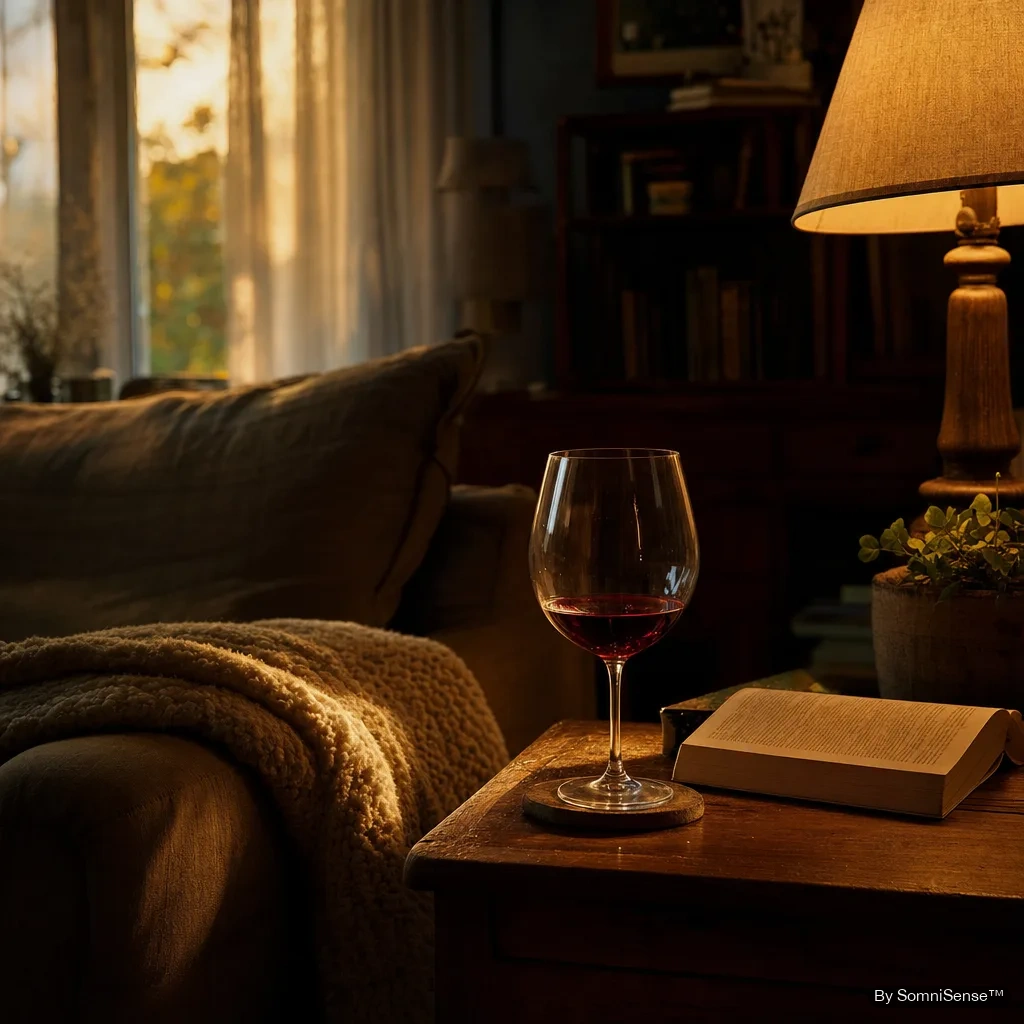
I want to be careful here, because I'm not trying to tell you not to drink. I had wine four nights a week for years before I ran the experiment that changed how I think about it. I'm a recreational drinker. I'm not a wellness influencer trying to sell you a sobriety lifestyle.
What I am going to do is explain the gap between the subjective experience of "wine helps me sleep" and what's actually happening to your sleep architecture. Both are real. They just point in opposite directions.
The three things wine does that feel like better sleep
1. You fall asleep faster
Alcohol is a CNS depressant. Your sleep latency — the time between turning off the light and being unconscious — drops. If you were 20 minutes before, you might be 8 minutes after. That feels great if you've been struggling to fall asleep.
This part is real. The catch is what happens next.
2. You feel relaxed at bedtime
The same CNS depression makes you feel mellow before bed. Your conscious mind interprets that as "winding down well." It's a strong, repeatable feeling that creates a strong association: wine = good sleep.
3. You don't remember waking up
This is the trickiest one. Alcohol fragments your sleep — but it also impairs the formation of memories during those fragmentation events. So you wake up six times in the night, your brain doesn't store any of those wake-ups, and you remember the night as "I slept through." The sleep was bad. The memory of the sleep was good. Those are not the same thing.
This is why most people who run a wine experiment with monitoring data are surprised. They felt fine. The data says they weren't fine.
What's actually happening, in order
Once you fall asleep with alcohol in your system, here's the rough timeline:
- Hours 0–4 — the liver is busy. Most of an evening drink gets metabolized in the first few hours. Heart rate stays elevated. REM sleep gets suppressed in the first half of the night. You're asleep, but your body is at work, not at rest.
- Hour 4–6 — the rebound. The liver finishes the job. Suddenly the sedative effect is gone, and the suppressed REM tries to come back all at once. Vivid, intense, sometimes anxious dreams. This is also when most people half-wake — wide-eyed at 3 a.m., hard to fall back asleep. Most people don't connect that wake-up to the wine they had at 7.
- The whole night — the airway. Alcohol relaxes throat muscles. The muscles that hold your airway open. If you're anatomically borderline (most adults are, to some degree), alcohol pushes you from "snoring lightly" to "snoring heavily" or even "occasional breathing pauses." Mike's BRI doubled. That's a typical, not extreme, response.
- The morning — the headache and fog. People blame this on the impurities in the drink (congeners). Some of that is real, especially with darker liquors. But the bigger driver in our data is overnight oxygen drops from a worse breathing pattern. Headache + foggy morning = downstream of the airway, not the wine itself.
None of these feel bad in the moment. All of them affect how you actually slept.
Why "I sleep great after wine" is the most common comment we hear
The conscious experience of falling asleep faster + feeling relaxed + not remembering wake-ups creates a powerful subjective sense of having slept well. That subjective sense is real. It's just not aligned with what the body is doing.
Sleep apps and wearables make this gap visible for the first time. The wine experiment from Mike's article is one of about 30 we've seen run by Lab Members so far. The pattern is consistent: most people who think wine helps their sleep are surprised by their data.
A few are not surprised. About 10% of people seem to have body chemistries where moderate wine has minimal measurable effect on overnight breathing. (That's not a license — there's still the daytime liver and HRV story — but for sleep architecture specifically, some people are more resilient.)
The only way to know which group you're in is to test.
What I'd do if I were starting
I'd run a 14-night experiment, like Mike did. Half the nights with one glass; half without. Track the data. Look at the result. Then make a decision based on numbers, not on how the wine made me feel at 9 p.m.
If your data shows what most people's shows — that wine measurably hurts your sleep breathing — you have a real choice to make. Not a moral one. A trade-off one. I personally chose to keep wine on Saturdays and skip it on weeknights. Some people skip it entirely. Some look at the data and decide they don't care, the wine is worth it. That's also fine. It's your night, and now it's your data.
The point isn't to give up wine. The point is to stop telling yourself wine helps you sleep when your body is showing you it doesn't. That's the only correction I'm trying to make.
Read next
If you'd rather see your own night than read about someone else's —
It's free on both stores. Put the phone on the nightstand tonight; the report is there when you wake up.
First 7 days of Pro are free · then $7.99/mo or $49.99/yr · cancel before day 8 and you pay nothing.