FEATURE · BREATHING PAUSE DETECTION
Hear the silence. See the duration. Know when it happened.
Breathing pauses and reduced breathing events are what clinicians count toward AHI. SomniSense detects both from your phone — with the same per-hour event-rate methodology used clinically.
Launching soon. First 7 days free at launch · then $7.99/mo or $49.99/yr.
A breathing pause is the part of the night you can't feel — breathing stops or drops for ten seconds or more, ends with a small wake-up you don't remember, and leaves you tired without knowing why. SomniSense counts those events from your phone's microphone, time-stamps each one, keeps the audio, and rolls them into a BRI on the same per-hour scale clinicians call AHI. Validated against in-lab PSG at 88.49% accuracy over n=80 paired nights. It's a monitor, not a diagnosis.
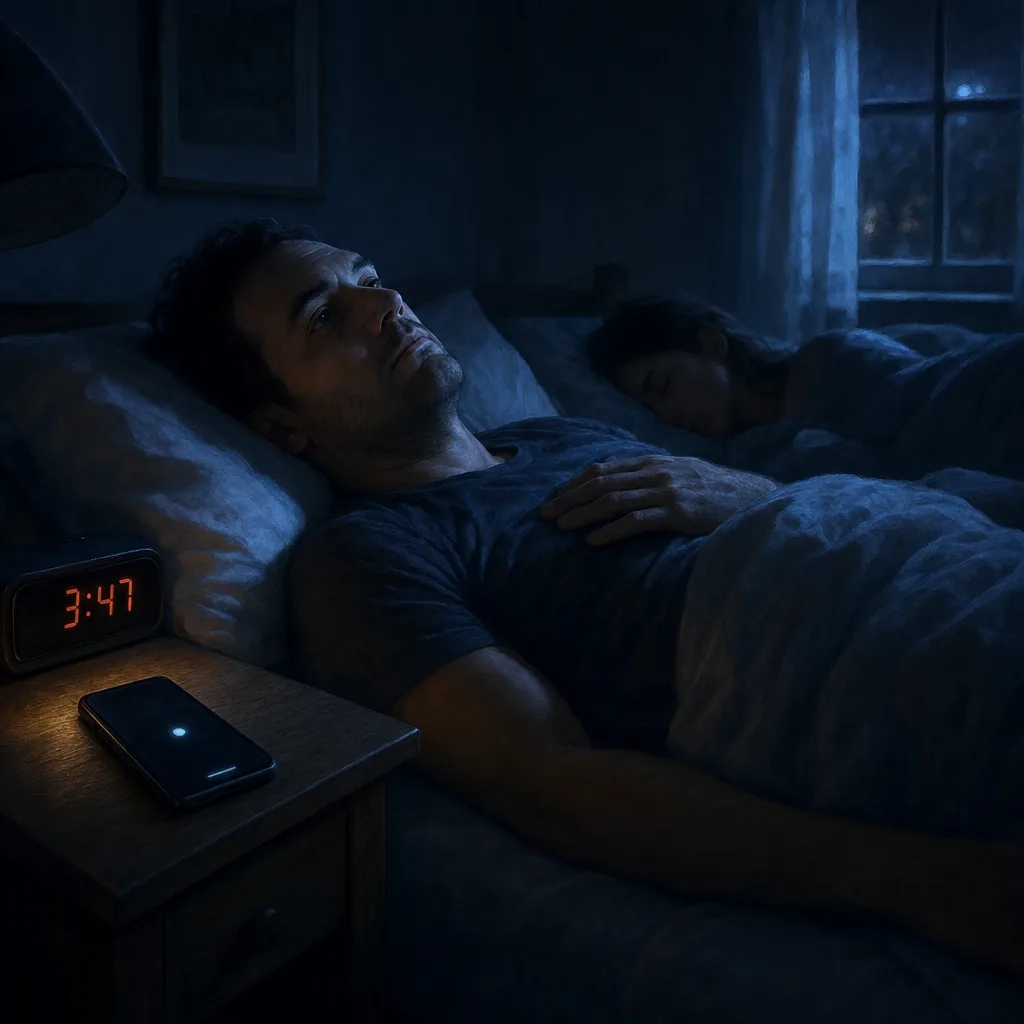
The first time I heard my own silence
The eleven seconds at 3:47 a.m. that I keep mentioning — that was a breathing pause.
You don't notice these when they happen because they end with a brief wake-up to breathe again, and the wake-up is short enough that conscious memory doesn't keep it. Your body remembers — that's why you're tired in the morning. The actual events are invisible to you in real time.
Two kinds, both counted, both visible
Sleep medicine counts two kinds of breathing irregularity:
- Apnea-like events — breathing fully stops for at least 10 seconds. Usually ends with a gasp or arousal. The silence is unmistakable when you hear it.
- Hypopnea-like events — breathing reduces by ~30% or more for at least 10 seconds. Acoustically subtler. Just as disruptive to oxygen levels and sleep architecture as full pauses.
Both count toward your BRI (Breathing Irregularity Index) — same per-hour event-rate scale clinicians call AHI in lab studies.
What you get every morning
- Apnea event count — full pauses ≥ 10 seconds
- Hypopnea event count — reduced breathing ≥ 10 seconds
- BRI per night, plus a 7 / 30 / 90-day trend
- Severity bucket — Normal <5 / Mild 5–15 / Moderate 15–30 / Severe >30
- Time-stamped event list — when each event happened, how long, what type
- Audio playback for any event (See & Hear)
Why we tuned for precision over sensitivity
The model is tuned precision-first by design — we'd rather miss a borderline event than flag a false one and damage your trust in the data. Paper E reports 88.49% accuracy and 88.06% F1 for the compressed model on 200-second windows. It does not publish a production sensitivity/precision pair, so we do not infer one from the uncompressed research model.
The trade: if PSG scored your per-hour event rate at 14, we might say BRI 11. But if we say BRI 18, you can trust it's at least 18. False alarms erode trust faster than missed events do, and we'd rather be the app that under-counts honestly than the one that over-flags for engagement. See the full methodology →
Reading the severity numbers
BRI uses the same scale clinicians use for AHI:
If your BRI runs above 15 consistently, that's a clinic conversation, not an app conversation. We give you the data. We don't tell you what to do with it.
The reason this number matters more after 50
Most consumer sleep apps avoid saying this directly. Each breathing pause briefly drops your blood oxygen. The brain is the most oxygen-hungry organ in the body. When sleep is the time the brain is supposed to be recovering — clearing waste, consolidating memory — and instead it's being intermittently under-supplied for years, that has a downstream cost.
The published research on untreated moderate-to-severe OSA over decades correlates it with hypertension, cardiovascular events, and accelerated cognitive decline. We're not the ones to tell you what your individual risk is — that's a sleep specialist with your full history. What we can do is make sure the number gets seen at 50, instead of getting noticed at 70 when it's already been quietly working against you for twenty years.
What this is not
- Not a diagnosis of obstructive sleep apnea (OSA). OSA diagnosis needs in-lab PSG or Type-III HSAT plus a sleep specialist's evaluation.
- Not validated for users under 18.
- Not a substitute for your CPAP's compliance report. If you're on CPAP, that machine's data is more authoritative for treatment decisions.
What it is: an acoustic estimator giving you organized evidence over weeks, so you can decide — with information — whether to seek clinical evaluation.
First 7 days of Pro are free · Cancel through the App Store or Google Play before day 8 to avoid the renewal charge.
Read next
- → How we validated accuracy
- → Every-Event Timeline — see each event individually
- → Doctor-Ready Cadence™ — bring this to your doctor