WITH · COMPLEMENTARY DATA
Use SomniSense with your Oura Ring
Oura is excellent at recovery — HRV, temperature, readiness. SomniSense covers what Oura can't see: the actual breathing pattern. Run them together and you stop guessing what's making your readiness scores fluctuate.
Your Oura readiness keeps dropping and you're wondering whether breathing is the cause. The ring measures from your finger — heart rate, HRV, temperature, periodic blood oxygen — but it can't hear the room. Tonight, free, the phone on your nightstand can: by morning you can play back the actual breathing pause, see it on a timeline, and decide for yourself whether it's worth a doctor visit. Nothing extra to wear.
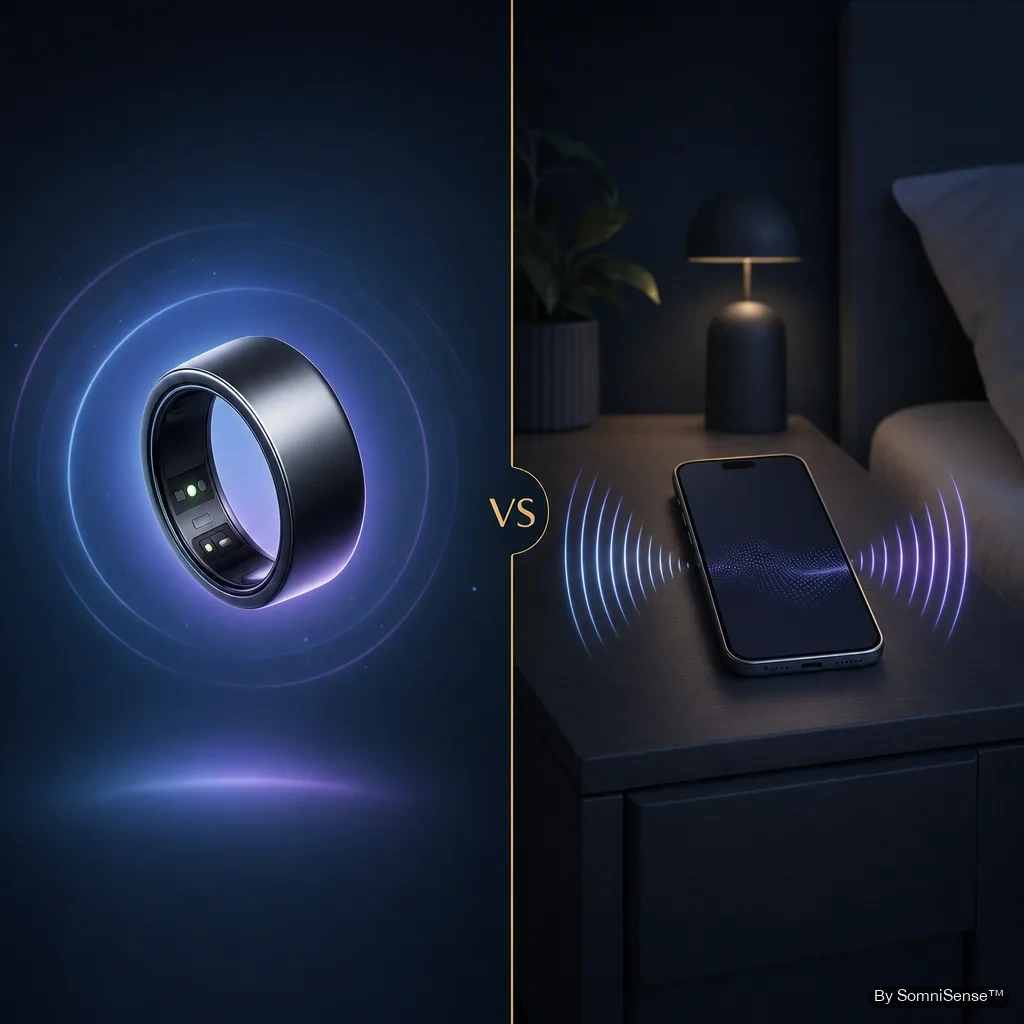
What Oura is genuinely good at
I'm a fan. I've worn one for almost two years. Oura does a few things that almost nothing else does as well:
- Resting HRV trend — over months, this is a powerful signal of how your nervous system is actually doing.
- Body temperature deviation — illness onset, hormonal shifts, alcohol's day-after impact, all visible.
- Readiness score — a single composite that pulls all of it into one number for the day.
- Quiet, comfortable wear — unlike a watch, you forget you're wearing it.
If you have one and you're using it, you're getting real data that matters.
What Oura can't see
The ring measures from your finger. That gives it heart rate, HRV, skin temperature, finger movement. It can infer a lot from that. What it can't do is hear the room.
If your readiness score has been mid-60s for three weeks and you can't figure out why, Oura will show you the symptom — your nervous system isn't recovering well — but not the cause. The cause might be alcohol. It might be 11 events of breathing pauses you don't remember. It might be your dog scratching at the door at 2 a.m. Oura can't tell those apart.
That's the gap. SomniSense fills it by recording the audio. The morning report shows you whether the disturbance was your dog, your snoring, or your breathing actually stopping for a stretch.
One small but meaningful difference: when the analysis happens
Oura's breathing-disturbance flagging — the feature that uses blood oxygen and respiratory rate to suggest possible apnea events — is computed by the ring's algorithm after you wake up and the data syncs to your phone. You see it in the morning. The trade-off is real and reasonable: a ring has limited compute, and overnight battery preservation matters.
SomniSense runs its detection on your phone, during the night. The events are time-stamped with second-precision and the audio of each one is preserved by morning. Same direction of insight — different timing, different evidence type. The blood-oxygen channel Oura has is genuinely valuable; we don't have that. The audio channel we have is genuinely valuable; the ring doesn't have that. Run them together and the picture is more complete than either alone.
What you get when you run both
| Question | Oura answers | SomniSense answers |
|---|---|---|
| How well did I recover? | HRV + temperature + readiness | — |
| How well did I breathe? | — | BRI + snoring + pauses |
| Was last night unusually disturbed? | Sleep stage shift | Time-stamped events |
| What disturbed it? | Heart rate signature | The actual audio |
| Did the wine I had affect me? | Tomorrow's HRV | Tonight's BRI + Lifestyle Lab™ over 14 nights |
| Should I see a doctor? | — | Doctor-Ready PDF (Pro) |
The pattern Lab Members notice in week 2
Most Lab Members who already had Oura tell us about a moment in week 2 of using SomniSense:
Their Oura readiness scores have been low for a while. They start tagging in SomniSense. By night 14, the Lifestyle Lab™ Factor Impact view shows that wine specifically — not large meals, not stress, not late workouts — moved their BRI by 4+ events per hour. Cross-referencing with Oura, those nights were also their lowest HRV.
They cut wine on weeknights. Oura's readiness score climbs over the next 30 days. SomniSense's 30-day BRI trend drops. Both apps confirming the same change.
That two-app correlation is what makes "I'll cut wine on weeknights" stick. Watching one number move is easy to dismiss. Watching two move together, in your data, is harder to argue with.
Free to start · Pro adds the multi-night before/after and the doctor-ready report · 7-day free trial, cancel before day 8 to avoid the charge.
Read next
Common questions
- If I have Oura, do I need SomniSense?
- If your Oura readiness scores are consistently solid and your partner hasn't said anything, no. SomniSense is what to add when readiness keeps being low and you're trying to figure out why — the breathing audio is what Oura can't capture.
- Will the ring and the phone conflict?
- No. The ring is doing its thing on your finger. The phone is doing its thing on the nightstand. They're independent.
- Why does Oura's sleep score and SomniSense's BRI not agree some nights?
- Because they measure different things. Oura's score blends heart rate, HRV, temperature, movement. SomniSense's BRI is a per-hour breathing-event count. A poor sleep score with a clean BRI suggests the issue is HRV / temperature / restlessness — not breathing. That's useful information.
- Can the data flow between them?
- Not yet, directly. Oura has an open API but the integration on our side is in active preparation. For now, you're comparing two views in two apps.