Lina, 32, moved her workout from 7pm to 5pm. Her BRI dropped 7 points.
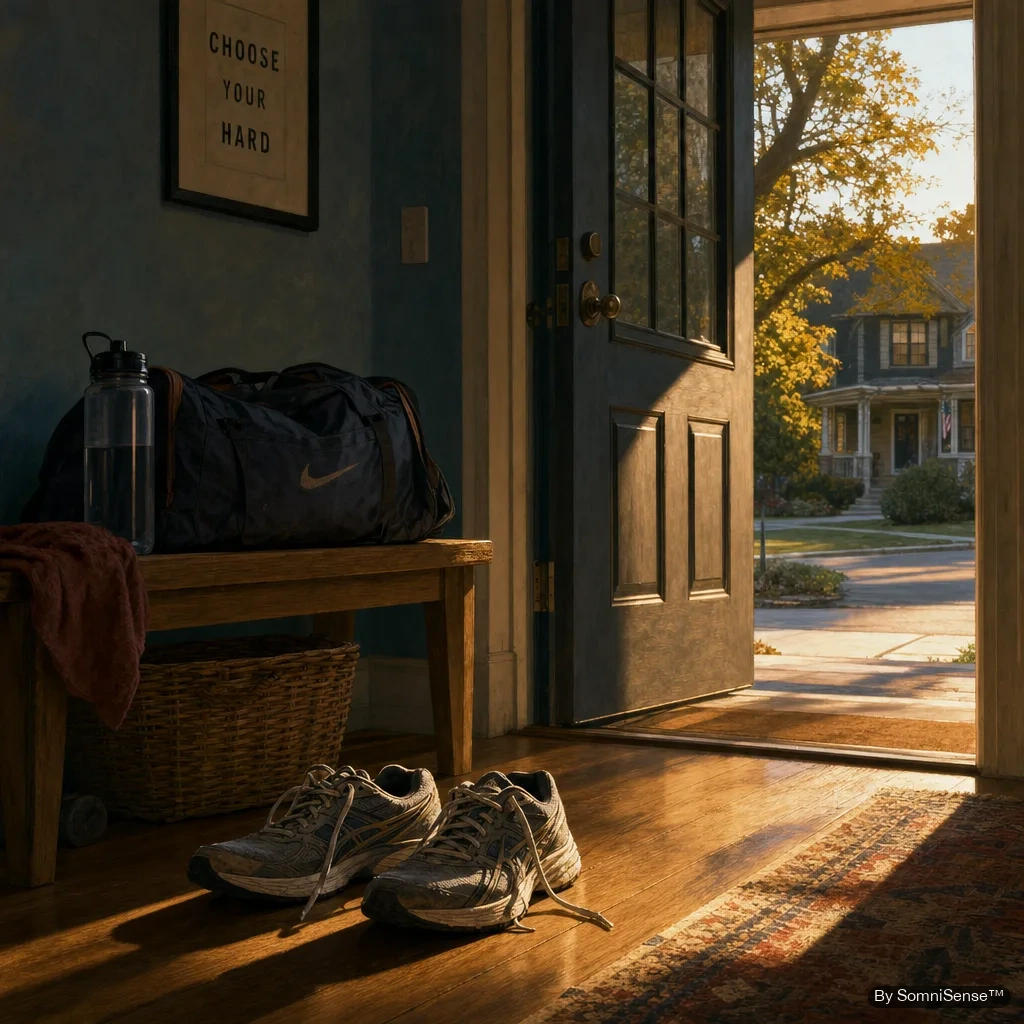
Lina is a marketing manager who does HIIT three days a week. She's healthy, she eats well, she's not a heavy drinker. The reason she joined the SleepWell Lab™ wasn't because she had a sleep problem — it was because her Oura readiness scores had been dropping over a stretch where everything else in her life was stable.
She suspected late workouts might be the issue. She'd been training at 7 p.m. (after work) for years and "knew" it didn't bother her sleep. So like Mike with the wine, she ran the experiment.
The setup
Lina ran a 14-night A/B with a single variable: workout timing.
- Group A — 7 nights: HIIT class at 7 p.m. (her usual). 45 minutes, treadmill intervals + kettlebell circuit. Bedtime: 11 p.m.
- Group B — 7 nights: Same exact HIIT class at 5 p.m. (the studio's earlier session). Same workout, same coach. Bedtime: 11 p.m. (held constant).
- All other variables held: same diet, same partner, same alcohol pattern (none on weeknights), same room temperature.
- Order: alternated, not randomized (same caveat as Mike's experiment).
She tagged each night in SomniSense Lifestyle Lab™ with "🏃 hard workout" and noted the timing in the free-text field.
The data
After 14 nights:
That's not subtle. The 7 p.m. group put her in the "mild" range. The 5 p.m. group was clearly normal.
The Oura data confirmed the direction. Average overnight HRV was 18ms higher on 5 p.m. workout nights. Sleep efficiency was 4 percentage points higher.
Why this might happen (the biology)
The leading explanation in sleep medicine — and I want to be specific that this is the leading explanation, not a definitive one:
- Core body temperature. Intense exercise raises your core temperature. Sleep onset and quality are tied to a falling core temperature. A workout that ends at 8 p.m. with bedtime at 11 p.m. gives you 3 hours to cool down — for some people, that's not enough. Ending at 6 p.m. gives you 5 hours.
- Cortisol. HIIT spikes cortisol. Cortisol is supposed to be at its daily low at bedtime. Late HIIT means cortisol is still elevated when you're trying to sleep.
- Sympathetic nervous system activation. Same direction. Your nervous system is in "go" mode, and "rest" mode is what you need.
For some people none of this seems to matter. They can do HIIT at 9 p.m. and sleep through. For Lina, and for many people, the 2-hour timing shift produced a measurable change.
What this experiment is and isn't
n=1, observational, not blinded, not randomized. Same caveats as Mike's wine experiment.
Important distinction from Mike's: the BRI improvement here was on someone whose baseline wasn't concerning. Lina's "before" BRI of 11.8 wouldn't have triggered a clinic visit. The "after" of 4.2 didn't change her medical category. What changed was her subjective energy and her Oura readiness.
Should you try this
If you do intense exercise in the evenings and your sleep tracking has been mediocre for unclear reasons, the timing experiment is worth running:
- Pick a 14-night window where you can actually control the variable (it's harder than the wine version because gym schedules are real)
- Same workout, two timings. The point is the timing, not the workout.
- Hold bedtime constant. If you also shift bedtime, you've added a confound.
- Tag every night honestly
- Look at your Factor Impact view at the end
You may find what Lina found. You may find your sleep is robust to workout timing and the answer is something else (caffeine? screens? stress?). Either is useful.
Read next
If you'd rather see your own night than read about someone else's —
It's free on both stores. Put the phone on the nightstand tonight; the report is there when you wake up.
First 7 days of Pro are free · then $7.99/mo or $49.99/yr · cancel before day 8 and you pay nothing.