Why your breathing gets worse around 4 a.m.
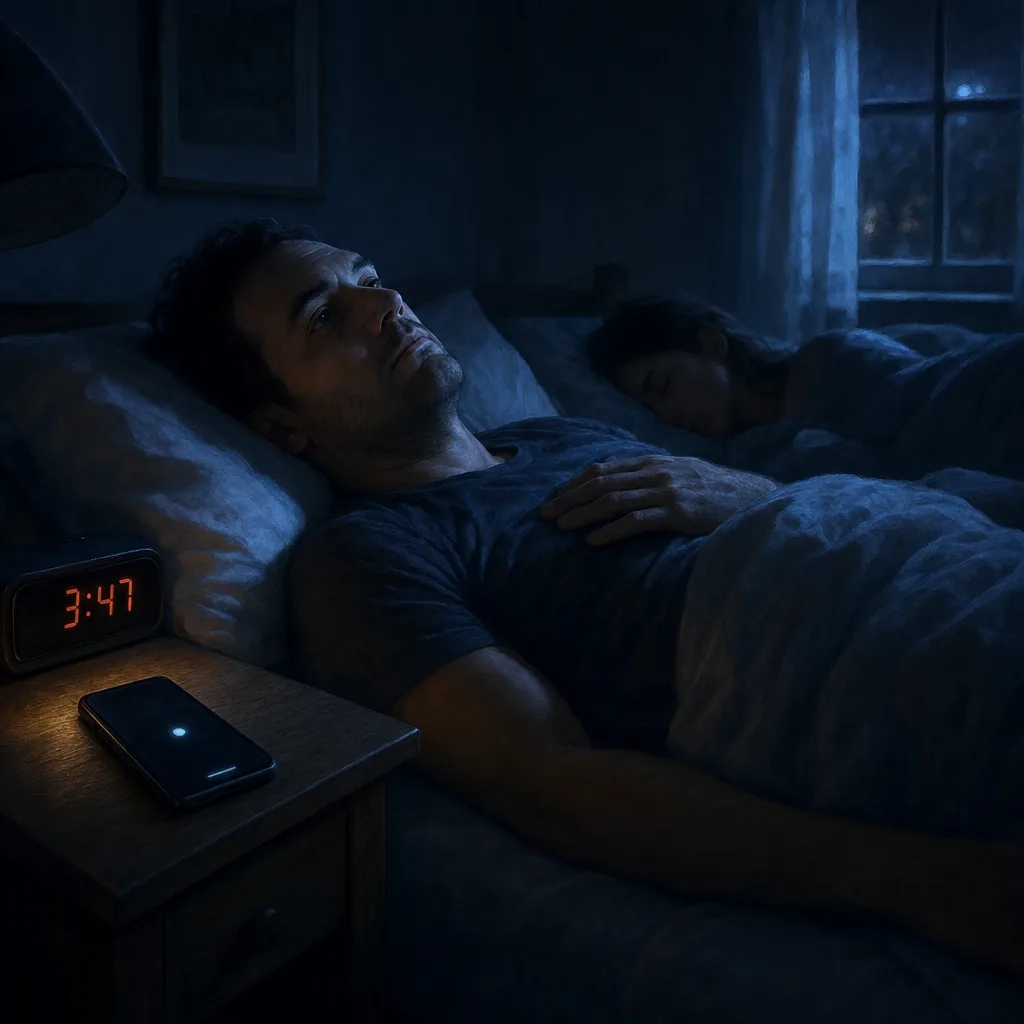
Here's a small observation from years of sharing a bed with someone who used to nudge me when I snored too loudly.
For a long stretch, my wife had a working theory of my nights: the loud-snoring stretches were the bad ones, and the quieter stretches in between were good. She'd elbow me when the rumble got too disruptive, I'd half-wake and shift, the sound would change, and she'd go back to sleep.
The data eventually told a different story. The "quieter stretches" she trusted were often clustered in the second half of the night — and that wasn't because my breathing was getting better. It was because something specific happens to bodies in the second half of the night that makes pauses more likely and snoring less audible. The label for it is mostly two words: REM and atonia.
What sleep is doing in 90-minute cycles
Adult sleep moves in cycles of roughly 90 minutes. Each cycle goes through a sequence: light sleep → deep sleep → a stretch of REM → back to light sleep, and around again. The composition shifts as the night progresses:
- First half of the night is heavier in deep (N3) sleep — the body's restorative phase. Long, dense, crucial for physical repair.
- Second half of the night is heavier in REM — the brain-active phase, where dreams concentrate and memory consolidation happens.
By around 4 a.m., for most people, REM is taking up a much larger share of each cycle than it did at 11 p.m. That's a normal, healthy pattern. But REM is also the stage where breathing gets hardest to maintain.
Why REM is harder for breathing
During REM sleep, the body essentially paralyses most of its skeletal muscles. The clinical term is REM atonia. The reason it exists is protective — without it, you'd act out your dreams. (When the mechanism breaks down, the result is REM Sleep Behavior Disorder, where people do exactly that, sometimes injuring themselves or partners.)
The atonia spares the muscles you can't live without — your heart, your diaphragm — but it relaxes nearly everything else. That includes the muscles in your throat that hold your airway open during sleep.
If you're someone whose airway is anatomically narrow or borderline, REM is when those muscles relax just enough to let it collapse. Snoring gets quieter or disappears as the airway moves from "narrowed and vibrating" to "narrowed and closing." Breathing pauses get longer and more frequent. Blood oxygen drops harder. The cycle ends with a brief, hard arousal — a gasp, a partial wake, a roll-over — and then back to a new cycle.
This isn't a failure of the body. It's the cost of REM doing its job. For most adults it's a non-event. For people with even mild OSA, it's why the second half of the night does most of the damage.
Why the average BRI hides this
Most sleep apps and clinical reports give you a single number for the night — average events per hour. That number is useful. It's also a flattening.
Two people can have a BRI of 8. The first has events spread evenly across 8 hours — basically tolerable. The second has all their events concentrated between 3 and 5 a.m., during peak REM. Same average, very different night. The second person's mornings will feel worse, their cognition will be more affected, and their long-term cardiovascular load is higher even though the headline number is identical.
If your BRI is in the "normal" range and your mornings still feel rough, this is one of the first things to look at. Open the per-hour timeline. If your events stack heavily into the second half of the night and most of them happen in your REM windows, that's a real pattern even if the average looks fine.
If you also wear a watch or ring
A wearable that estimates sleep stages — Apple Watch, Oura, Whoop, Fitbit, take your pick — can usually show you when REM was concentrated. Cross-reference with the timestamps from your breathing-event timeline. The two will often line up. The watch tells you when the body was in REM; the breathing data tells you what was happening to the airway during it. Both are evidence. Together, they're a pretty clean argument.
What to do with this information
Three things, in order:
- Stop optimizing on snore loudness alone. If your loudness drops in the second half of the night, that isn't necessarily good news. Watch the breathing-pause count alongside it.
- Stop optimizing on average BRI alone. If your number is normal but your mornings aren't, the timeline view is the next thing to look at — not the next pillow.
- Bring the timeline to a sleep specialist if it's clustered. "My average AHI was 6, but most of those events were in REM" is a sentence a clinician can do something with. "I keep waking up tired" is a sentence they have to start from scratch with.
Read next
If you'd rather see your own night than read about someone else's —
It's free on both stores. Put the phone on the nightstand tonight; the report is there when you wake up.
First 7 days of Pro are free · then $7.99/mo or $49.99/yr · cancel before day 8 and you pay nothing.