Why your sleep audio never leaves your phone.
When I describe SomniSense to people, there's a moment where their face changes. "Wait — it records audio? All night? In my bedroom?" Yes. And I understand exactly why that lands wrong, because if that audio went to a server somewhere, I'd be uncomfortable too.
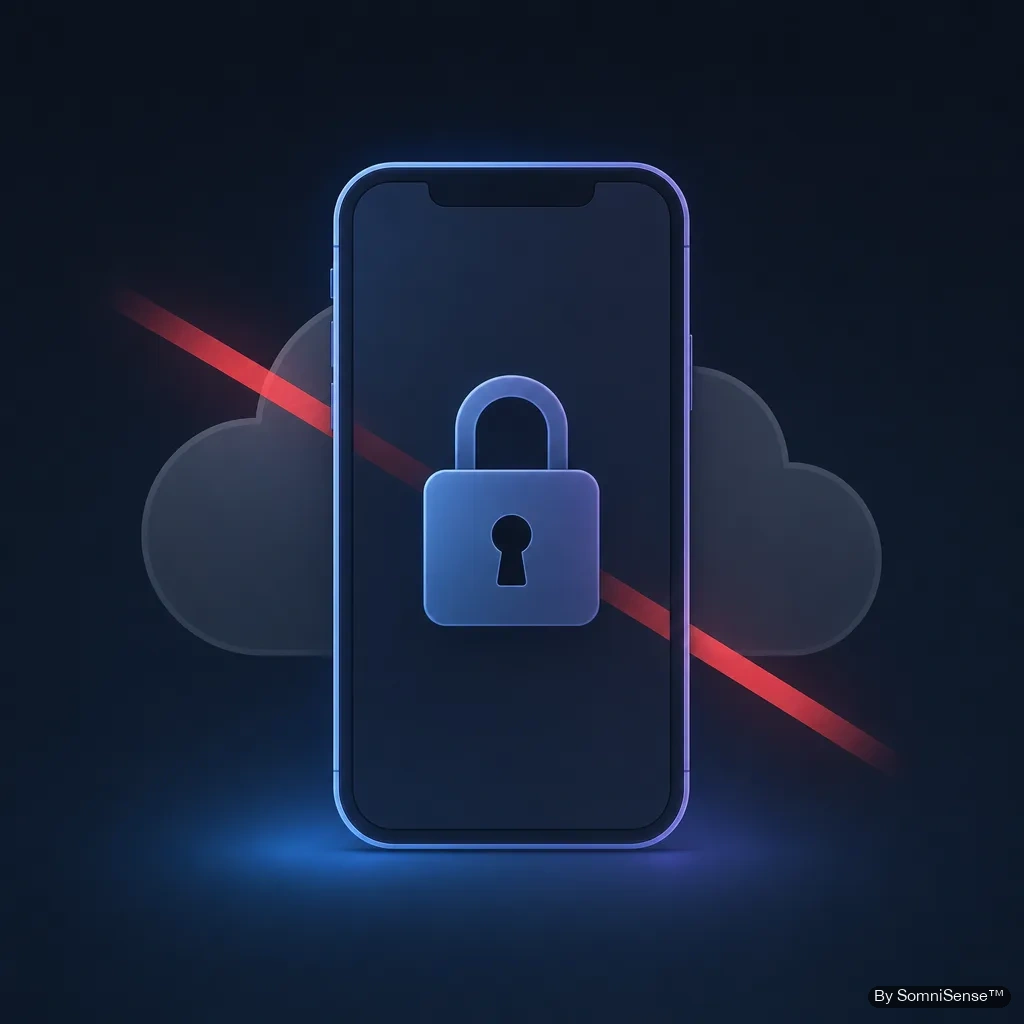
So here's the thing I lead with now: the audio never leaves your phone. It isn't uploaded, it isn't stored in our cloud, it isn't anywhere I could get to it even if I wanted. And the reason I can say that confidently isn't a privacy policy. It's the way the thing is built.
"On-device" gets said a lot. Here's what it has to mean.
Plenty of apps say "on-device" and mean "we do a little on the phone and send the rest up." Real on-device means the entire job — listening, deciding what's a snore, counting breathing pauses, building your morning report — happens inside the phone, with the network off. Nothing leaves.
The hard part is that this is genuinely difficult to pull off. A model that can analyze a night of audio is normally big — too big and too slow to live on a phone. The usual shortcut is to ship the audio to a powerful server and let it do the thinking. That shortcut is exactly what creates the privacy problem: once your bedroom audio is on someone's server, it can be logged, breached, subpoenaed, or quietly used to train something.
We made the model small instead
The way out was to make the model small enough that there's no reason to send anything anywhere. The version of SomniSense that ships is under 60 kilobytes — smaller than a single photo — and makes each decision in a fraction of a millisecond, running on the same on-device neural hardware your phone already uses for things like face unlock. (If you want the exact figure and the chip it was measured on, it's on the research page.)
Getting there wasn't one clever trick; it was a two-stage design that throws away almost everything before the heavy work happens, plus a compression pass that shrinks the network without losing accuracy. If you want the actual architecture — how a one-second listener feeds a longer reader, and how the model gets compressed — that's written up on the research page, including the preprints behind it.
The point for you is simpler: small model, on your phone, no cloud. Privacy stopped being a promise I make and became a fact of the design.
What this does and doesn't mean
It means your raw audio stays with you. What syncs — if you turn sync on at all — is the derived stuff: your nightly numbers, your tags, your trends. Not the recordings. You can keep or delete the audio clips on your own device.
It does not mean SomniSense knows more about your health than a doctor does. It's a wellness monitor. It surfaces a pattern from sound. What that pattern means medically is still a clinician's call — we just made sure the raw material of it never has to leave your nightstand to be useful.
Read next
- → The research behind SomniSense — the two-stage model and how it gets small enough to run locally
- → Why most sleep trackers don't tell you about your breathing — the physical reason a wrist can't do this
- → See & Hear playback — how the audio you keep on your device works in the app
If you'd rather see your own night than read about someone else's —
It's free on both stores. Put the phone on the nightstand tonight; the report is there when you wake up.
First 7 days of Pro are free · then $7.99/mo or $49.99/yr · cancel before day 8 and you pay nothing.