SYMPTOM GUIDE · LAYER 3 EDUCATION
Why Is My Snoring So Loud?
If your partner has moved to the spare room, if hotel neighbors knock on the wall, if you wake yourself up — yes, loud snoring is a real thing, and it's worth taking seriously. Tonight, free, you can play back your own snoring and see how loud it really got, from the phone by your bed.
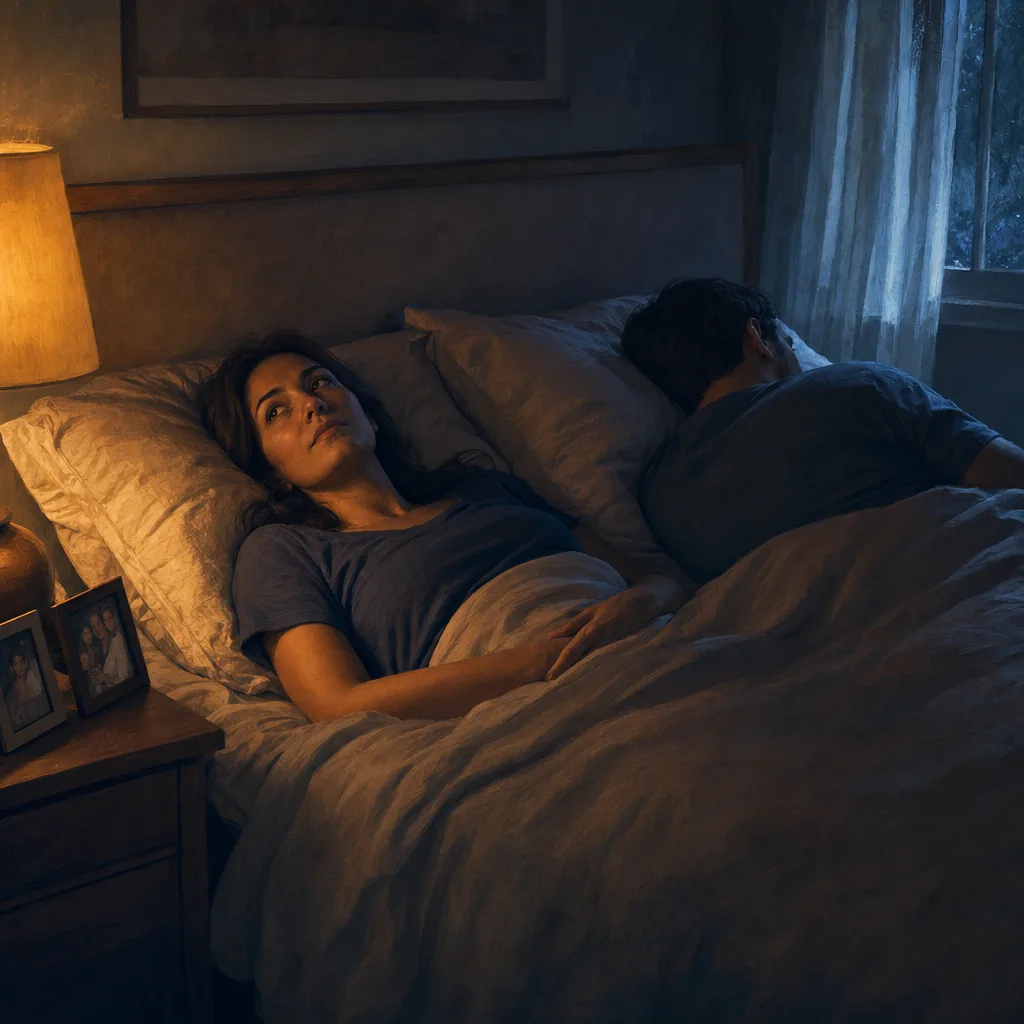
Loud snoring is more than a punchline. Across studies of adult snorers, partners report measured peaks of 60–90 dB — comparable to a vacuum cleaner running next to your face.
Loud snoring matters for two reasons:
- Relationship cost — partners are losing sleep too.
- Possible signal — louder, more obstructive snoring patterns are statistically more associated with breathing irregularities (hypopneas, apneas).
That doesn't mean every loud snorer has sleep apnea. It means loud snoring deserves attention — not just earplugs.
Snoring finally has its own number
Most apps give you a peak loudness ("68 dB") and call it a night. That tells you almost nothing — was it one peak or 400? Was it spread evenly or concentrated 02:00–04:00? Two snorers with the same peak number can have completely different nights.
So we built SRI (Snoring Rate Index) — events per hour, the same shape as the breathing-side BRI (and the clinical AHI). Plus a per-minute Q/L/M/H texture so you can see when the heavy minutes happened, not just how many.
- Quiet — under 30 events/hour. The night your partner doesn't bring it up.
- Light — 30 to 100/h. Audible-but-tolerable.
- Moderate — 100 to 300/h. Persistent. Probably mentioned.
- Heavy — over 300/h. Wall-to-wall.
SRI thresholds are product-defined, not clinical — they're our bands, not a medical scale. The detection underneath them is validated against PSG (see the callout below); the full methodology lives at /accuracy. Read it first if you want to argue with our numbers.
The 4 patterns of snoring (and what each suggests)
Not all loud snoring is the same. SomniSense and sleep specialists classify snoring into 4 acoustic patterns, each pointing to a different anatomical source:
🔊 Palatal snoring (most common)
The soft palate vibrates as air passes. Classic "rumble." Typical triggers: back-sleep, alcohol, weight gain. Often improves with: side-sleep, weight loss, anti-snore pillow.
🔊 Tongue-base snoring
The tongue falls back, partially blocking the airway. Lower-pitched. Typical triggers: alcohol, sedatives, deep sleep stages. More associated with breathing pauses — worth tracking closely. Often improves with: avoiding alcohol within 3 hours of bed, side-sleep, head-of-bed elevation.
🔊 Epiglottic snoring
The epiglottis (cartilage above the voicebox) flaps during inhale. Often quieter but irregular. More associated with apnea events; worth a specialist consult if frequent.
🔊 Nasal snoring
The "whistle" or "whine." Usually from congestion or narrow nasal passages. Often improves with: saline rinse, nasal strips, treating allergies.
If you don't know which pattern is yours, you're guessing at interventions. SomniSense classifies your snoring acoustically so you don't have to guess.
Six things to try tonight (in order of cost and effort)
- Side-sleep tonight. Sew a tennis ball into a t-shirt. Crude but works. ~50% of palatal snorers see meaningful drops.
- Skip alcohol within 3 hours of bed. Alcohol relaxes the throat muscles that hold your airway open.
- Elevate the head of your bed 4–6 inches. Use blocks under the bedposts (not extra pillows — those bend your neck the wrong way).
- Try an anti-snore pillow ($30–60). Holds head/neck in a position less prone to palatal collapse.
- Try nasal strips or saline rinse if your snoring is whistling or you wake congested ($5–15).
- Lose 5–10 lbs if you're carrying extra weight, especially around the neck. Even small reductions help meaningfully.
How to actually tell which of these works on you → — pillow, nasal strips, spray, mouth tape, side-sleeping, one honest measure for all of them.
Don't try them all at once. Tag one intervention per night for 14 nights, see which one actually moved YOUR data. SomniSense's Lifestyle Lab™ feature is built exactly for this.
When loud snoring isn't just loud snoring
See a sleep specialist if you (or your partner) notice any of these:
- You stop breathing for visible periods, then gasp.
- You wake unrefreshed regardless of how long you slept.
- You fall asleep at red lights or during meetings.
- Morning headaches more than 3 days a week.
- Your BRI (or AHI on a clinical study) is consistently above 15.
- Your blood pressure is rising for no other clear reason.
In the United States, the standard pathway is: GP referral → sleep specialist consult → home sleep apnea test (HSAT) or in-lab polysomnography → diagnosis & treatment plan.
SomniSense doesn't replace this pathway. It can give you objective data to bring to the consult.
How SomniSense helps
- ✅ Snore type classification (which of the 4 patterns is yours)
- ✅ See & Hear Playback — press play on the loudest snores
- ✅ Per-event timestamps — see when in the night your snoring peaks
- ✅ Lifestyle Lab™ — test interventions on YOUR body, not population averages
- ✅ 30/90-day trends to confirm an intervention is working
- ✅ PDF export to bring to a sleep specialist
Free plan: tonight's report + 7-day trends. Pro ($7.99/mo or $49.99/yr — first 7 days free, cancel anytime through Apple or Google): 30/90-day trends + Factor Impact + PDF export.
Common questions
Does loud snoring always mean sleep apnea?
No. Loud snoring increases statistical association with breathing irregularities, but many loud snorers have no apnea. The way to know is to measure — SomniSense's BRI uses the same per-hour event-rate scale clinicians use clinically.
Can losing weight stop my snoring?
Often, yes. Even 5–10 lbs of neck-area weight loss can meaningfully reduce snoring intensity. But not for everyone. Track YOUR BRI before and after to know if it's working for you.
Are anti-snore mouthpieces worth trying?
They help some people, especially tongue-base snorers. They can also worsen jaw pain. Consult a dentist with sleep medicine training before custom-fitting one.
How do I know which of the 4 snore types is mine?
SomniSense classifies your snoring acoustically every night. Tonsillar/palatal vs tongue-base vs epiglottic vs nasal — each has different intervention paths.
My partner records me with their phone. Is that the same as SomniSense?
Phone recordings are a great start. SomniSense adds: per-event timestamps, snore type classification, breathing-pause detection, BRI scoring, and trend analysis over weeks. The recording is just the first 5 minutes of the data picture.
First 7 days of Pro are free · Cancel through the App Store or Google Play before day 8 to avoid the renewal charge.
Read next
- → How accurate is SomniSense? — validated against PSG, n=80
- → Snoring Detection — Deep dive on snore type AI
- → Lifestyle Lab™ — Test interventions properly
- → What actually works for snoring — pillow, strips, spray, tape, side-sleeping
- → Partner says I snore — what now?
What if you could bring a PSG-style report to your doctor next visit?
SomniSense doesn't just track tonight. Every Sunday morning at 7am (your local time), Pro subscribers receive a doctor-ready PDF in your inbox — formatted exactly the way your sleep specialist reads HSAT reports. Print it. Bring it to your appointment. Forward it to your partner. That's how data becomes care.