SYMPTOM GUIDE · LAYER 3 EDUCATION
My Partner Says I Snore. What Now?
When your partner tells you that you snore — or worse, that you sometimes stop breathing — the temptation is to dismiss it ("I sleep fine"). The better move is data — and tonight, free, you can get it: play back your own night and see the snoring and breathing pauses for yourself.
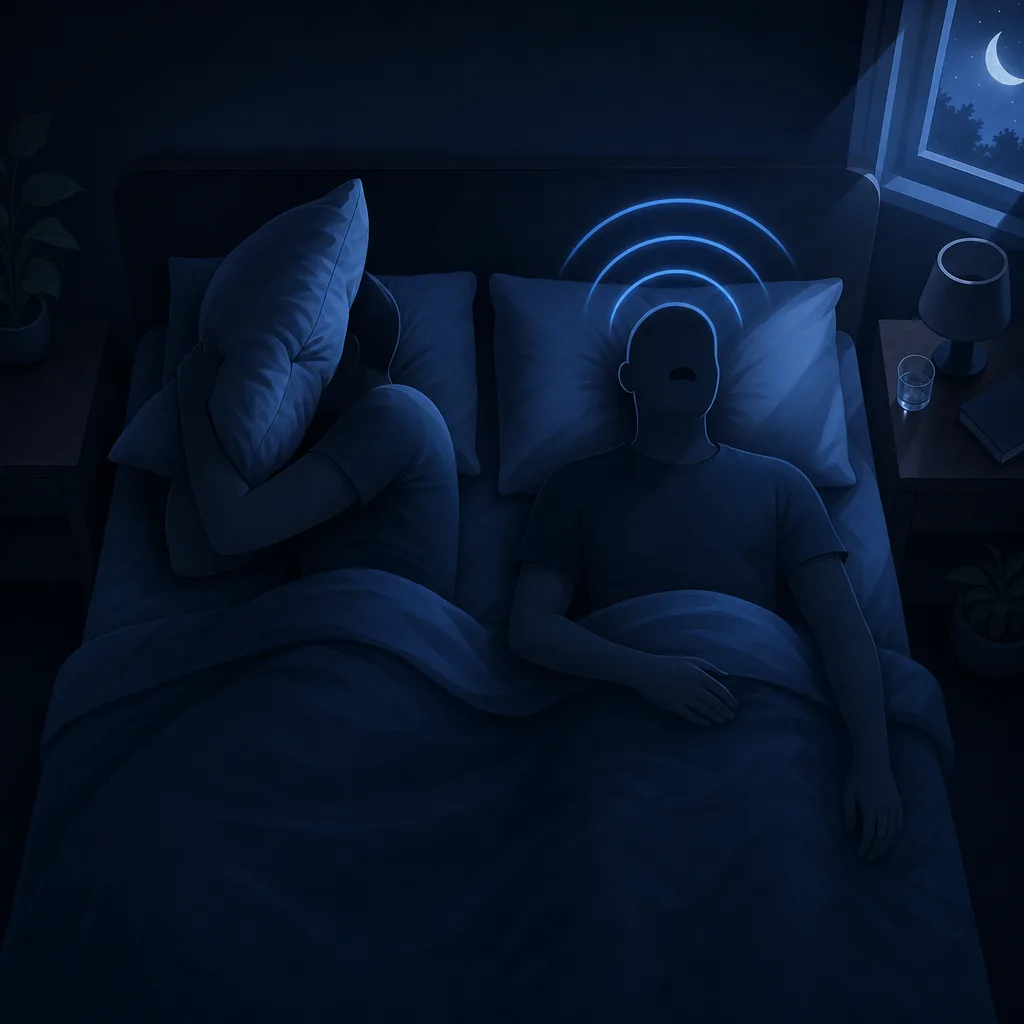
If you've been told you snore, you're in a club of about 45% of adult men and 30% of adult women, depending on which study you read. So this is normal in the statistical sense — but that doesn't mean it's harmless, and it definitely doesn't mean it's not affecting your partner.
Two things to take seriously up front:
- Your partner is sleep-deprived because of you. Even if you sleep "fine," they probably aren't. Adult sleep partners of snorers lose an average of 1+ hour of quality sleep per night.
- You can't self-assess this. Whether you stopped breathing for 30 seconds at 3 a.m. is genuinely unobservable from the inside. Your partner is your best evidence — until you have a recording.
What your partner's exact words tell you
The way your partner describes your snoring matters more than the fact that you snore. Listen for these specific phrases:
🟢 "You snore steadily, kind of rhythmic."
Likely simple snoring (palatal). Annoying for your partner; lower personal health concern.
🟡 "You snore really loud."
Loud snoring increases the statistical likelihood of underlying breathing irregularities. Worth tracking.
🟠 "You snore and then it gets really quiet... and then you gasp."
This is the classic OSA description. Take it seriously. Schedule a sleep specialist consult, regardless of how you feel.
🔴 "You stop breathing. I count the seconds. I get scared."
This deserves prompt clinical attention. Capture data, but don't wait months — book the appointment.
🟢 "You snore only when you've been drinking / sleeping on your back."
Position-dependent / alcohol-dependent. Often very responsive to lifestyle changes.
The variety of these descriptions is exactly why a recording matters. Your partner's memory at 3 a.m. is approximate. SomniSense gives you objective per-event audio.
Don't argue. Record.
The mistake almost everyone makes is debating what happened ("It wasn't that bad, you're exaggerating"). This rarely ends well, because:
- Your partner is right about the experience.
- You are right that you don't perceive it.
- Both can be true.
A better script:
You: "You're right that I can't tell from the inside. I'll record tonight with the SomniSense app on my phone. Let's look at the data together in the morning."
Then in the morning:
- Open the report together.
- Press play on the loudest events.
- Press play on any breathing pauses.
- Talk about what you both want to do.
This converts a relationship conflict into a shared project. The data does the convincing.
If snoring is confirmed: a 4-week plan
Week 1 — establish baseline
Use SomniSense every night. Don't change anything. Record what your typical BRI / snoring is.
Week 2 — try side-sleep
Tag every night. Sew a tennis ball into a t-shirt or use a side-sleep belt. Compare BRI vs Week 1.
Week 3 — try alcohol-free weeknights
If you drink in the evenings, try 5 dry weeknights vs 2 normal. Tag accordingly. Compare.
Week 4 — combine the interventions that worked
Use Lifestyle Lab™ Factor Impact view to confirm which ones moved YOUR BRI most.
If after 4 weeks BRI is still above 15 or your partner still reports breathing pauses: see a sleep specialist. Bring the PDF report.
How to test each fix you'll try in weeks 2–4 → — pillow, nasal strips, spray, mouth tape, side-sleeping, measured the same honest way.
Some descriptions warrant immediate action
Book a sleep specialist now if your partner reports any of:
- Repeated breathing pauses they can count seconds during
- Gasping / choking arousals
- You appear to wake yourself up panicking
- You've fallen asleep at the wheel or while talking
The 4-week experiment is appropriate when the evidence is "loud snoring" or "occasional pause." It's NOT appropriate when the evidence is consistent observed apnea — that goes straight to a clinician.
Why SomniSense fits this exact situation
- ✅ Settles the "is it bad" debate with audio you can both hear
- ✅ Snore type classification (helps choose interventions)
- ✅ Per-event audio playback for any pauses your partner reported
- ✅ Lifestyle Lab™ — turns the 4-week plan above into a structured experiment
- ✅ PDF export for the sleep specialist if you escalate
Free: 7-day data + 5 audio plays a night. Pro (7 days free, then $7.99/mo or $49.99/yr — cancel anytime through Apple or Google): 30/90-day trends + Factor Impact + unlimited audio + PDF.
Common questions
My partner is exaggerating. Right?
Probably not. Adult sleep partners of snorers lose an average of 1+ hour of quality sleep per night. The data will tell you definitively in one night.
My partner uses earplugs. Does that solve it?
It solves their immediate sleep, not your potential underlying breathing issue. If they need earplugs, your snoring is loud enough to investigate.
How do I bring this up without it becoming a fight?
Frame it as data, not blame: "I want to record tonight and look at the actual evidence with you." That converts a relationship debate into a shared project.
What if the data confirms severe apnea?
You see a sleep specialist. SomniSense's PDF export gives you 14–30 days of organized evidence to bring. Many specialists welcome patient-prepared summaries.
My partner doesn't want to deal with it. Should I just ignore?
No. Even if your partner stops complaining, untreated severe OSA correlates with cardiovascular risk over years. Track for yourself if not for them.
First 7 days of Pro are free · Cancel through the App Store or Google Play before day 8 to avoid the renewal charge.
Read next
- → How accurate is SomniSense? — validated against PSG, n=80
- → The acoustic side of loud snoring
- → When pauses are happening
- → See & Hear Playback — the audio that ends arguments
- → Lifestyle Lab™ — run the 4-week experiment properly
- → What actually works for snoring — pillow, strips, spray, tape, side-sleeping
What if you could bring a PSG-style report to your doctor next visit?
SomniSense doesn't just track tonight. Every Sunday morning at 7am (your local time), Pro subscribers receive a doctor-ready PDF in your inbox — formatted exactly the way your sleep specialist reads HSAT reports. Print it. Bring it to your appointment. Forward it to your partner. That's how data becomes care.