SYMPTOM GUIDE · LAYER 3 EDUCATION
Why Do I Wake Up Gasping for Air?
Waking up gasping, choking, or feeling like you can't catch your breath is one of the more concerning sleep symptoms. Tonight, free, you can capture the actual event on your phone — hear it, see it timestamped — instead of wondering.
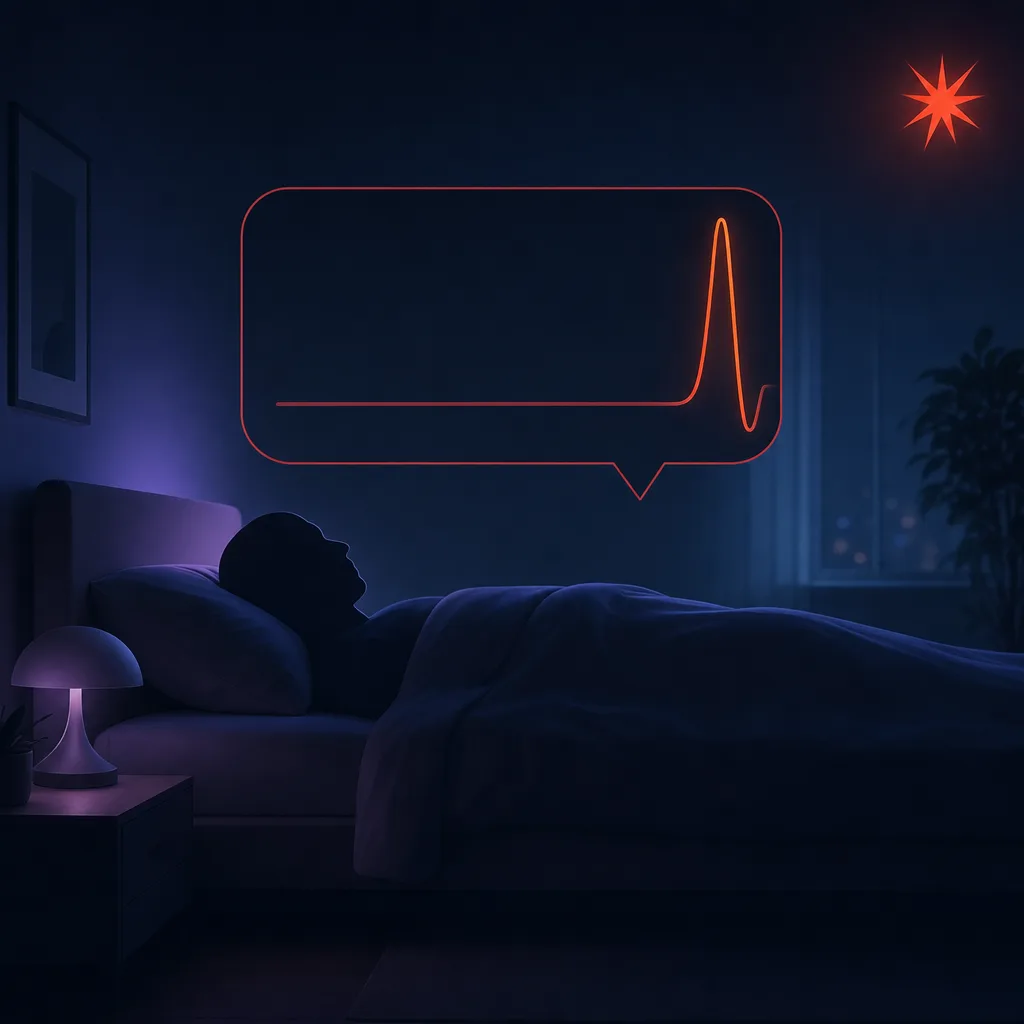
If you've ever bolted upright at 3 a.m. with your heart racing and your throat feeling like it just opened up — that's not a nightmare. That's most likely your brain rescuing you from a paused breath.
This kind of arousal is one of the most distinctive markers of obstructive sleep apnea, and unlike snoring, it tends to grab attention quickly. The good news: of all sleep symptoms, gasping arousals are among the easiest to capture acoustically — meaning you can actually verify what's happening.
What gasping arousals usually indicate
The most common pattern is this:
- Airway partially closes during sleep (often during REM, when muscle tone drops).
- Breathing slows or stops for a number of seconds (10–30 is common for moderate apnea; longer in severe cases).
- Blood oxygen drops, blood CO₂ rises.
- The brain triggers an emergency arousal — adrenaline surge, muscles re-engage, airway opens.
- You wake gasping. Heart pounding.
- Within a minute, you fall back asleep — and the cycle may repeat.
This is the classic obstructive sleep apnea (OSA) cycle. But other causes exist:
- Severe acid reflux (laryngospasm) — stomach acid hits the vocal cords, which slam shut as a protective reflex. Feels like choking. Distinct from apnea but co-occurs often.
- Anxiety-related panic awakenings — sympathetic nervous system fires on its own, no airway involvement.
- Cardiac issues — paroxysmal nocturnal dyspnea (PND), a heart-failure symptom. Less common but important to rule out.
- Medications — some sedatives can paradoxically cause airway-related arousals.
The right next step: capture the data, then see a clinician.
What you can do tonight
1. Don't dismiss it. Gasping arousals more than once a week warrant a sleep specialist consult, period. This isn't a "wait and see" symptom.
2. Capture the data. Most clinicians can't tell from your description alone whether you had 3 events or 30. SomniSense records every breathing pause with timestamp, duration, and audio playback.
In the meantime, lower-effort changes that often help:
- 🛌 Side-sleep. Back-sleep dramatically increases obstructive events. Train side-sleep with a tennis-ball t-shirt for 2 weeks.
- 🍷 No alcohol for 3 hours before bed. Alcohol is one of the largest single triggers of severe airway events.
- 📐 Elevate the head of bed 4–6 inches. Helps both apnea and reflux.
- 🍽️ Don't eat large meals within 3 hours of bed. Reduces both apnea (diaphragm pressure) and reflux risk.
These are not treatments. They're risk-reducers while you get a proper assessment.
When to see a specialist — and what to bring
See a sleep specialist if:
- Gasping arousals occur more than 1× per week
- Your partner observes you stop breathing
- You have daytime sleepiness (Epworth Sleepiness Scale ≥ 11)
- You have hypertension that doesn't respond to medication
- You're 50+, male, or have a neck circumference > 17 inches (women > 15 inches)
📋 Bring with you:
- A 7–14 day SomniSense report (PDF export, Pro feature)
- Notes on when arousals happened (date, approximate time)
- Audio recordings of any captured events (SomniSense lets you play these back; some specialists are very interested)
- Your medication list
- Your partner's observations if available
The specialist will likely order a home sleep apnea test (HSAT) — a 1–3 night recording with a small chest band and finger sensor. If results are borderline, an in-lab polysomnography (PSG) follows.
How SomniSense helps
- ✅ Per-event timestamps for every breathing pause ≥ 10 seconds (the clinical apnea threshold)
- ✅ Per-event audio — you can press play on the actual gasp
- ✅ Time-of-night patterns — when in your sleep most events happen
- ✅ PDF export formatted for clinician review
- ✅ Lifestyle Lab™ — see if side-sleep / no-alcohol actually reduces events on YOUR data
Free: tonight's report + 7-day history. Pro (7 days free, then $7.99/mo or $49.99/yr — cancel anytime through Apple or Google): 30/90-day trends + PDF export + unlimited audio playback.
Common questions
How often is "too often" for gasping arousals?
More than once a week is a sleep specialist consult, period. Once a month or less is worth tracking but less urgent.
Is this related to my heart?
Possibly. Paroxysmal nocturnal dyspnea (PND) is a heart-failure symptom that can present similarly to OSA arousals. If you have known heart issues or new chest discomfort, ask your GP to differentiate.
When should I go to the ER?
If you have chest pain, severe shortness of breath that doesn't resolve in minutes, or new neurological symptoms — yes, go to the ER. Single isolated gasping arousals without other symptoms are not ER events.
Can I just record myself with my phone?
Phone audio is a great start. SomniSense adds: precise event timestamps, breathing-pause vs gasping-arousal classification, BRI scoring, and a multi-week pattern view that one night of audio can't give you.
What if my BRI is normal but I still gasp awake?
Other causes (acid reflux, anxiety, cardiac) can cause similar arousals. A normal BRI helps narrow the differential — bring the data to your GP.
First 7 days of Pro are free · Cancel through the App Store or Google Play before day 8 to avoid the renewal charge.
Read next
- → How accurate is SomniSense? — validated against PSG, n=80
- → How we detect breathing pauses
- → Every-Event Timeline — See every event with timestamps
- → Partner says I snore — what now?
What if you could bring a PSG-style report to your doctor next visit?
SomniSense doesn't just track tonight. Every Sunday morning at 7am (your local time), Pro subscribers receive a doctor-ready PDF in your inbox — formatted exactly the way your sleep specialist reads HSAT reports. Print it. Bring it to your appointment. Forward it to your partner. That's how data becomes care.