WITH · COMPLEMENTARY DATA
Use SomniSense with your Fitbit
Fitbit gives you the high-level sleep picture — duration, stages, restlessness. SomniSense adds the layer Fitbit's wrist sensor can't pick up: each individual breathing event, time-stamped and replayable.
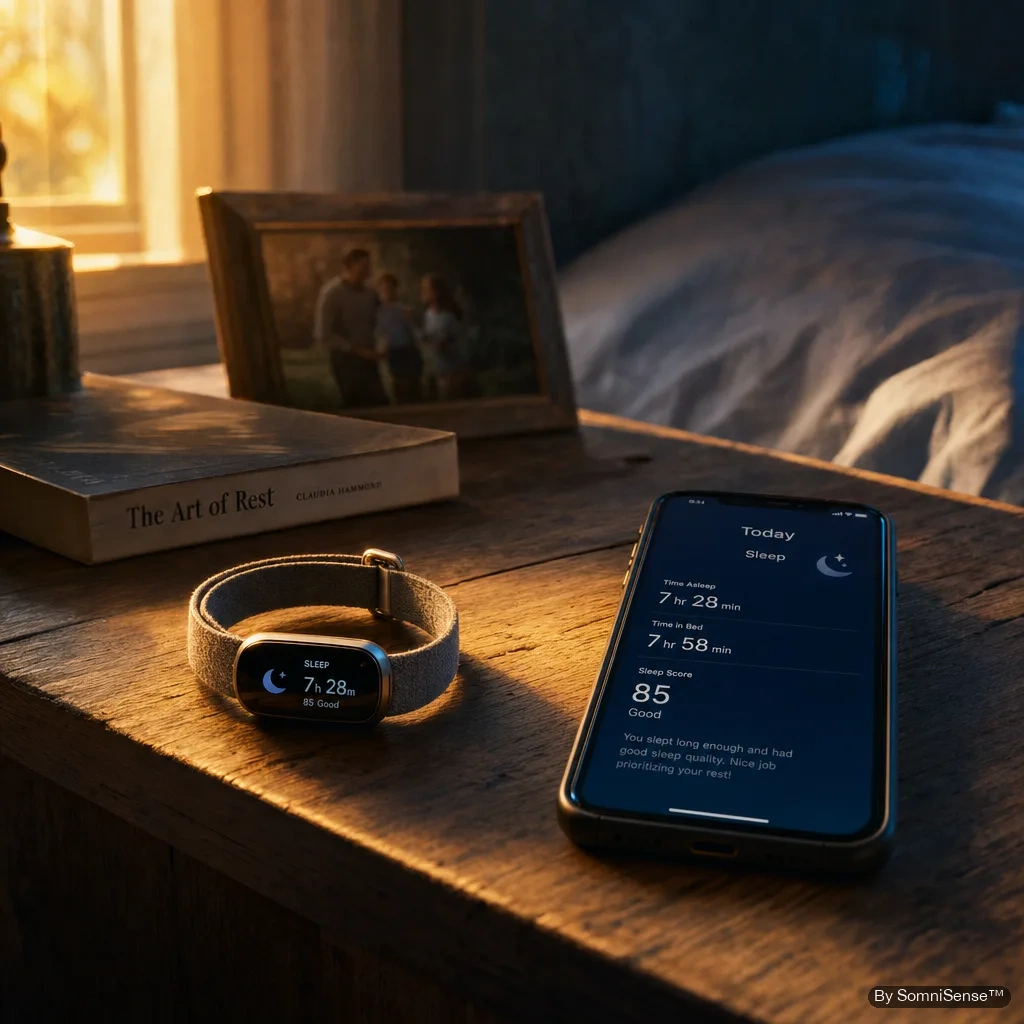
What Fitbit's been doing well for years
Fitbit's been at sleep tracking longer than almost anyone in this space. They built a lot of the early consumer expectations — "your sleep score" as a daily morning check-in, sleep stage estimation, restlessness graphs. If you've worn a Fitbit, you've probably already developed some intuition for whether your nights are good or bad based on the score.
That's real value. I'm not going to dismiss it.
What's worth saying clearly: Fitbit's wrist sensor is excellent for the kind of measurements you can pick up from skin contact — heart rate, movement, occasional SpO2 sampling, inferred sleep stages. It's not trying to capture sound. So the breathing event layer is where it has a natural blind spot.
What SomniSense adds, specifically
The breathing pattern in your night is acoustically detectable. The snoring is. The breathing pauses are. The hypopneas are.
None of that is in your Fitbit data. Your sleep score might be 82 with a "good" rating while you had 18 breathing events per hour overnight. The Fitbit didn't see those events because they're not visible from the wrist. SomniSense did, because the microphone heard them.
Concretely:
- Per-event timestamps + audio — you can hear the 11-second silence at 3:47 a.m.
- Snore type classification — palatal vs tongue-base vs nasal vs epiglottic.
- BRI on the same per-hour scale clinicians use for AHI — bring it to a doctor.
- Lifestyle Lab™ — tag factors and see what moves YOUR breathing pattern over 14 nights.
What you get when you run both
| What you want to know | Fitbit answers | SomniSense answers |
|---|---|---|
| How long did I sleep? | Total + stages | — |
| How restless was I? | Movement events | — |
| Did I have breathing events? | Estimated breathing rate variation | Per-event count + types + audio |
| Was my sleep score low for breathing reasons? | Indirectly | Directly — BRI shows it |
| Why was my deep sleep cut short? | Could be many reasons | If breathing events clustered late, you'll see it |
| What's making my numbers worse / better? | — | Lifestyle Lab™ |
| Bring data to a doctor | Manual export | Auto-emailed weekly + monthly PDF (Pro) |
If your Fitbit score keeps disappointing you
This is the case where pairing them helps the most.
You've been wearing a Fitbit for months. Your sleep score keeps coming back in the 70-78 range. Not bad enough to take to a doctor. Not good enough that you feel rested. You don't know what to fix.
Here's the thing: Fitbit can show you that your sleep was fragmented. It can't easily show you what fragmented it. It might have been alcohol. It might have been your dog. It might have been 14 breathing pauses a night you have no conscious memory of.
SomniSense lets you tell those apart. Tag the alcohol nights. See if BRI moves. Hear the events Fitbit's score is reflecting indirectly. Often, the missing piece is right there in the audio.
First 7 days of Pro are free · Cancel through the App Store or Google Play before day 7 to avoid the renewal charge.
Read next
Common questions
- Will SomniSense replace Fitbit's sleep score?
- It's not trying to. Fitbit's sleep score covers stages, time asleep, restlessness — that whole picture. SomniSense adds breathing detail and per-event audio that the Fitbit's wrist sensor can't capture.
- Do I need both?
- Only if you're trying to understand the breathing piece specifically. If your Fitbit sleep scores are consistently fine and you have no other concerns, you don't need SomniSense. If your scores are mediocre and you can't figure out why, the breathing layer is the most likely missing piece.
- Can the apps share data?
- Not yet. Fitbit's data lives in Fitbit (and partly in Google Health Connect on Android). SomniSense's data lives on your phone. The integration is in active preparation.
- I have a really old Fitbit. Does this still apply?
- Yes — even a basic Fitbit gives you sleep duration and restlessness. SomniSense complements that with the breathing layer regardless of which Fitbit model you have.