Why "catching up on sleep" on the weekend often makes you feel worse.
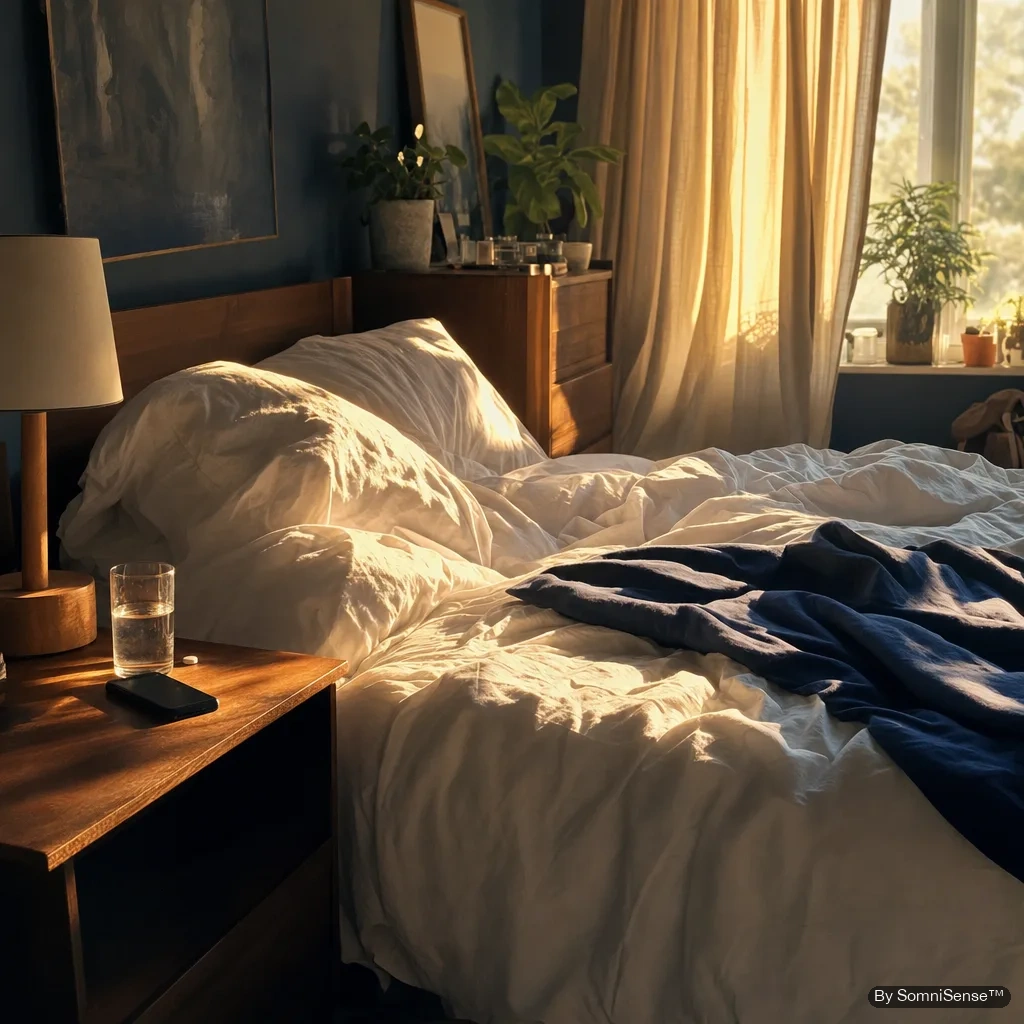
You stayed up late Friday. Maybe drank a couple. Slept in until 10:30 Saturday. Felt OK Saturday afternoon. Slept in again Sunday until 11. Walked into Monday morning still feeling like you hadn't slept enough.
If that pattern is familiar, you're not alone, and you're not lazy. You're running into a counter-intuitive part of how sleep actually works that the "8 hours per night" folk wisdom doesn't address.
I want to walk through what's usually happening, because once you see it, the fix is much smaller than "go to bed earlier" — and much more useful.
What sleep is mostly about, that nobody tells you
The advice you've heard your whole life is about sleep duration. Hours. The advice that turns out to matter at least as much, maybe more, is about sleep regularity — how close in time your sleep happens from one night to the next.
Your body runs on roughly a 24-hour internal clock that takes its cues from light, food, activity, and habit. When the timing of when you sleep stays close to consistent night-to-night, that clock stays in tune. When it doesn't — when Friday is "1 a.m. to 7 a.m." and Saturday is "2 a.m. to 11 a.m." and Sunday is "10:30 p.m. to 6:45 a.m." — the clock is being asked to shift back and forth like a small jet-lagged passenger every weekend.
Researchers call this "social jet lag." The label is accurate. The body responds to it about the way it would respond to actually flying east two time zones every Friday and west two time zones every Sunday.
The three things actually making the long weekend morning worse
1. The clock shift itself
Sleeping until 11 a.m. Saturday tells your body's clock that "11 a.m." is a reasonable wake time. Then you ask it to wake up at 6:30 a.m. Monday. From the body's point of view, you just landed in a new city. Energy is low, focus is poor, mood is cranky — even though, by the calendar, you slept plenty.
2. The drinks (if there were any)
Weekend evenings are where most adult drinking lives. The two-glass-of-wine Friday isn't the same as the no-wine Tuesday from your body's point of view. Alcohol relaxes throat muscles, suppresses REM in the first half of the night, and metabolizes around 4 a.m. with a wake-up that often feels like a heart-rate spike. You went to bed at midnight, technically slept until 11, but the middle of that span was disturbed in ways you may not consciously remember.
(More on the alcohol part: why you think wine helps you sleep when it doesn't.)
3. The position
Long weekend mornings tend to involve more time on the back. More back-sleeping means more snoring, more breathing pauses, lower oxygen. So the "extra hours" you got after the alarm would have gone off are sometimes lower-quality hours than the regular 7-hour weekday sleep.
Stack those three together — clock shift, alcohol, more back-sleep — and it's not surprising that 9 hours on Sunday can feel worse than 7 hours on Tuesday.
What I changed for myself, in case it's useful
I'm not going to tell you to give up Friday nights. I drink. I stay up late on weekends. I'm just going to share what moved my own pattern, because the small adjustments turn out to be where the leverage is.
- Cap the wake-up shift to ~90 minutes. If I usually wake at 6:30, I won't sleep past 8:00 on weekends. Going-to-bed time can shift further; the wake-up time is the one that matters most for the clock.
- If alcohol, lighter and earlier. One drink with dinner at 7 p.m. is materially different from three drinks at 11 p.m. The 4 a.m. metabolic wake-up is the one that wrecks the second half.
- Take a short walk in morning light. 10 minutes outside before 9 a.m. on Sunday signals "this is morning" to the clock harder than three espressos.
- Side-sleep, even on the long mornings. The pillow-behind-the-back trick works. Your numbers will thank you.
None of these are dramatic. The point isn't to be a sleep monk. It's that the easy mistake is over-correcting in the morning ("more hours") when the actual lever is the timing.
What to look for in your own data
If you track with SomniSense or a wearable, the pattern is visible. Find a typical "stayed up late and slept in" Saturday morning, then compare it to a typical Tuesday. Look at:
- BRI / breathing event count
- Sleep efficiency (if your tracker reports it)
- HRV the day after, if you have a wearable
- Subjective morning energy
If three of those four are worse on the weekend day, you've personally confirmed that sleeping in didn't actually buy you what you thought it bought. That's not a moral failure — it's just data, and now you can decide what to do with it.
Read next
If you'd rather see your own night than read about someone else's —
It's free on both stores. Put the phone on the nightstand tonight; the report is there when you wake up.
First 7 days of Pro are free · then $7.99/mo or $49.99/yr · cancel before day 8 and you pay nothing.