Can a Phone Detect Sleep Apnea?
SomniSense cannot diagnose or screen for sleep apnea using a phone recording. It can detect candidate acoustic patterns and let you check the estimated time, marked waveform and sounds before and after a possible pause. Published window-classification accuracy does not establish whether you have OSA, how many clinical events occurred, or whether a quiet night rules it out.
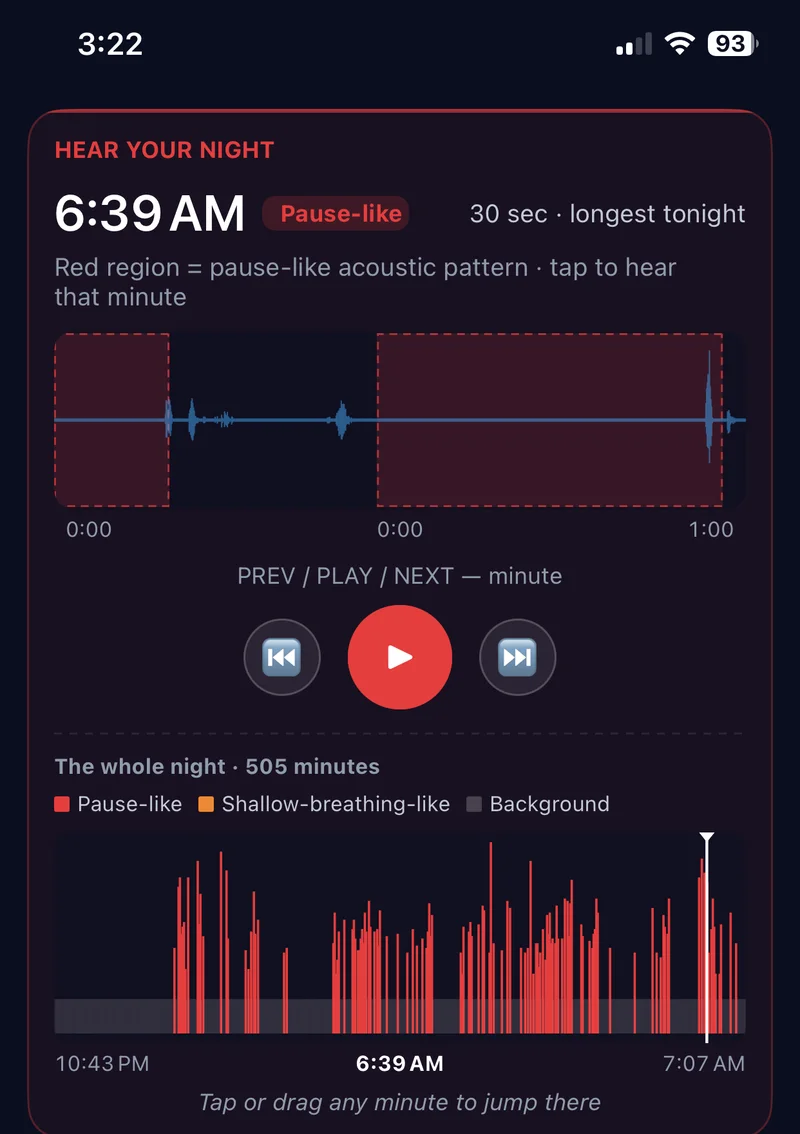
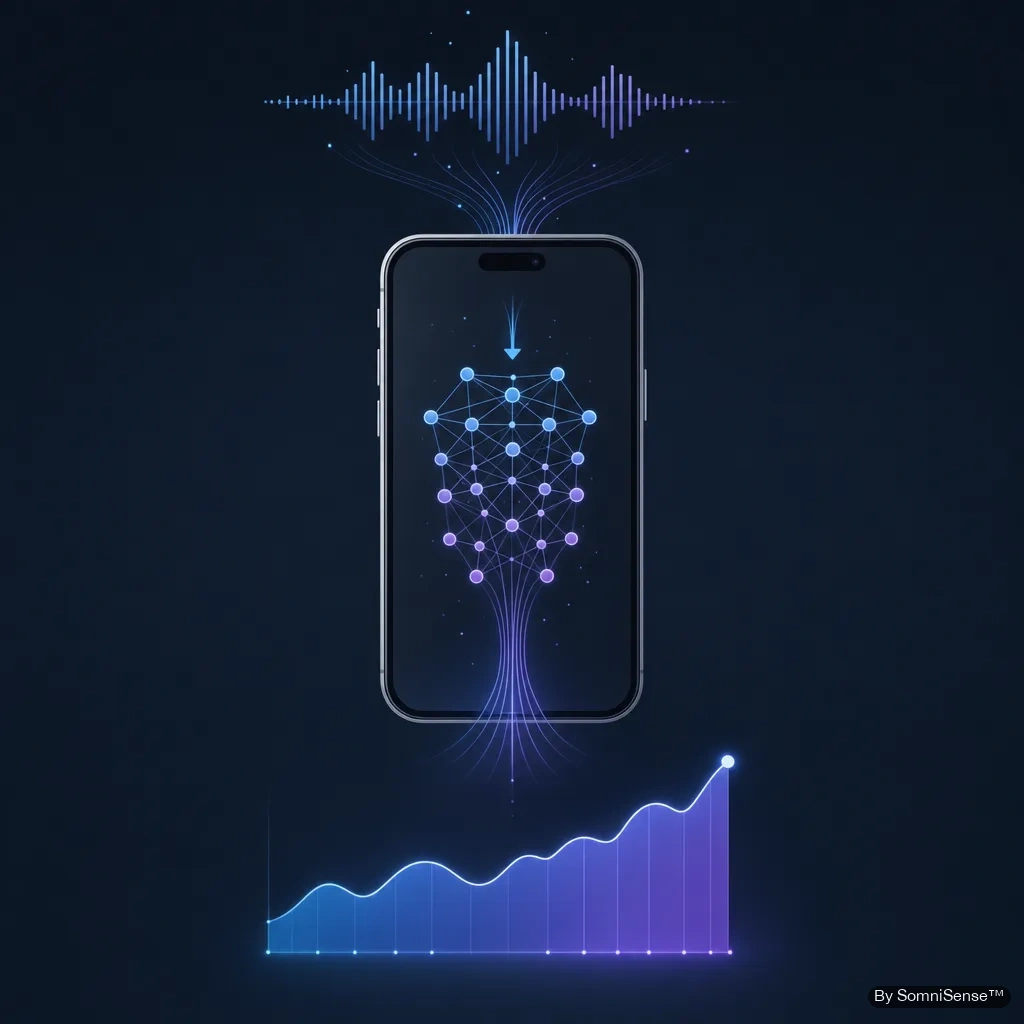
It's a fair thing to be skeptical about. A clinical sleep study straps a dozen sensors to you — airflow, oxygen, chest movement, brain waves. SomniSense uses one microphone, sitting on the nightstand, two feet away. So when someone asks me "how accurate can that possibly be," I don't think they're being rude. I think they're asking the right question.
The honest answer is task-specific. A microphone model can be evaluated for a defined acoustic classification task, while PSG measures physiological signals for clinical interpretation. Those are different jobs, so one number cannot describe the whole product.
Why an accuracy number needs a named task
A large percentage is incomplete unless it says accurate at what. Classifying a one-second snore segment, classifying a labeled 200-second breathing window, and producing a whole-night product summary are different tasks. Evidence for one must not be transferred to another.
These two measures answer different error questions:
- Sensitivity — among the reference annotations in the evaluation set, how many did the model detect?
- Precision — among the model's detections in that evaluation set, how many matched a reference annotation?
Sensitivity and precision can move in different directions. Publishing both helps readers understand the tradeoff instead of treating a single blended metric as a complete description.
What our numbers actually are
So, plainly. For 1-second snore-event detection, the five-seed means are 91.67% sensitivity and 89.01% precision. For 200-second breathing-event windows, the compressed model reports 88.49% accuracy and 88.06% F1. Those are research-cohort classification benchmarks, not a personal accuracy guarantee for tonight's SRI or BRI.
I'm deliberately not going to unpack every one of those here, because that's a longer, more careful read, and I'd rather you have it in full than in a blog-sized summary. The number-by-number version lives on the accuracy page, and the study design and the model behind it — how a phone gets to those numbers at all — is on the research page.
The honest part: where it's weaker
Production performance can vary with phone placement, room noise, microphone, partner sounds, and patterns near a decision boundary. The published 200-second window benchmark does not establish a one-sided guarantee for an individual's BRI.
Noise, another sleeper, a fan near the microphone, and unsupported ages can all affect the fit between a benchmark and a personal night. The published cohort was adults; SomniSense is not for users under 18.
Read next
- → The research behind SomniSense — the validation study and the on-device model, in plain language
- → What "validated against PSG" should tell you — why the testing method matters as much as the number
- → The full accuracy breakdown — every metric with its task and limits
Record tonight. Take a closer look tomorrow.
Download SomniSense for iPhone or Android and start with Free. Your first Night Report helps you review what the phone recorded, including any candidate breathing moments. No candidates is a possible result too; it cannot rule out a medical condition.
Free covers the first-night core experience · Pro adds longer history, 30/90-day views, comparisons and fuller English reports
See how to review the evidence →
Sources checked September 6, 2026: NHLBI · NIH.