COMPARISON · DIFFERENT EVIDENCE UNITS
SomniSense vs SnoreLab — what does each app preserve?
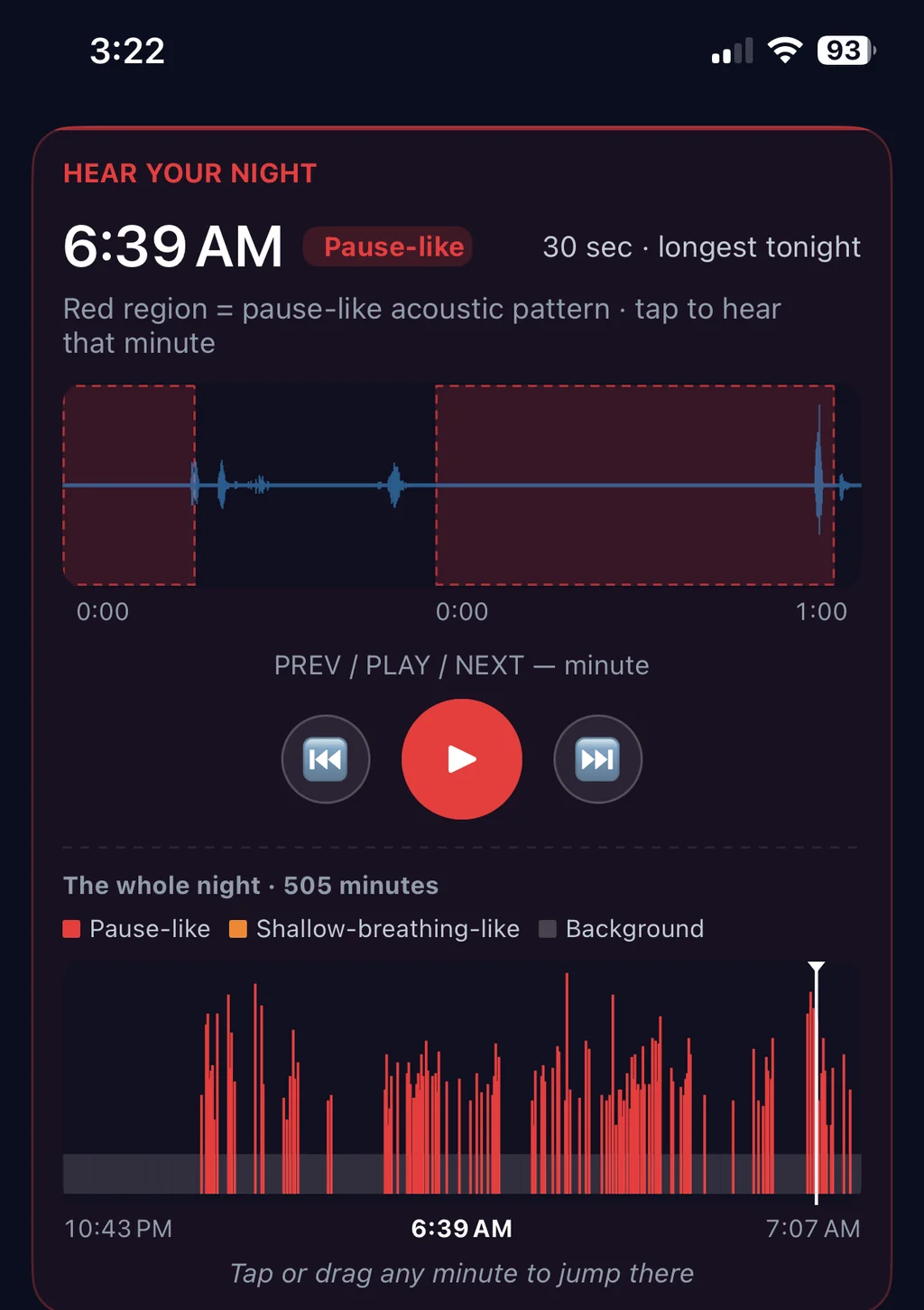
Both apps let you review recorded sleep sounds. SnoreLab offers BreathFlow and BDI breathing summaries. SomniSense centers the possible pause you can open: estimated time and duration, a marked waveform, and the sounds before and after. Neither app diagnoses sleep apnea.
SnoreLab is no longer just a snore-loudness app. Its public materials describe BreathFlow, a Breathing Disturbance Index, trends and recording playback. The useful difference is more specific: SnoreLab's breathing view starts with 30-second stability windows, while SomniSense lets you move from the whole night to a selected minute, its waveform, the marked candidate region and playback of the sounds before and after the quiet interval.
Side-by-side, kept honest
On a phone, swipe the table sideways to compare both apps.
| SomniSense | SnoreLab | |
|---|---|---|
| Main consumer question | Where was a possible breathing pause, and what can I see and hear around it? | How did snoring and breathing stability vary, and what patterns appeared alongside tagged remedies? |
| Breathing evidence unit | Candidate acoustic event with model-estimated time, type, duration and waveform region | 30-second BreathFlow window labeled Normal, Reduced or Low |
| Whole-night index | BRI from candidate acoustic events per estimated sleep hour; not AHI | Snore Score plus SnoreLab BDI and BreathFlow summaries |
| Audio review | Candidate-context playback, subject to local retention and access limits | Recording samples; Premium also offers full-night and all-snoring playback modes |
| Across-night observation | Personal baseline, tagged-vs-untagged comparisons and structured reports | Trends plus remedy and factor tracking |
| Published validation focus | 1-second snore segments and 200-second breathing windows; n=80 PSG reference nights | Whole-night BreathFlow screening and BDI comparison tasks described in SnoreLab's white paper |
| Clinical boundary | Wellness observations; not AHI, PSG, HSAT or diagnosis | Wellness observations; not a diagnostic tool |
| Additional hardware | None — uses the phone already beside your bed | None — uses a phone microphone |
When SnoreLab is the better fit
You want a mature snoring-management workflow: Snore Score, intensity, recordings, BreathFlow, BDI, trends and remedy tracking in one familiar product. You may also prefer its playback modes for scanning samples or a full-night recording.
That is a substantial product, not a lesser version of SomniSense. If those are your questions, SnoreLab may be the better fit.
When SomniSense is the better fit
Your question is specific: did a possible breathing pause occur, when was it, and what did it sound like before and after? SomniSense puts that candidate in the night so you can open its minute, see the estimated duration and follow the waveform while listening.
It then carries that same evidence into a personal baseline, tagged-night comparisons and a structured wellness report. That is a different evidence workflow, not a claim that a phone becomes PSG.
What each method gives up
SnoreLab's public breathing workflow is intentionally built around 30-second stability windows and whole-night aggregation. Those units support a clear consumer screening and trend experience, but its public materials do not report event-level onset, offset or duration error.
SomniSense preserves a finer candidate-event structure in the product. The trade-off is just as important: bedside audio cannot tell whether a quiet region came from airway obstruction, quiet nasal breathing, a change in phone position, room noise or another cause. It does not measure airflow, oxygen, respiratory effort or sleep stage.
Can you run both at the same time?
You can use both products over the same period, but do not assume two microphone apps can record reliably on one phone at the same time. Alternate nights or use separate devices if you want a cleaner comparison.
Do not expect the numbers to match. Snore Score, BreathFlow, SnoreLab BDI and SomniSense BRI use different definitions and should be read inside their own product context.
What this page isn't
This page is not an accuracy shoot-out. SnoreLab's whole-night screening results and SomniSense's labeled window-classification results are not the same task. A larger percentage on one page would not settle which product answers your question better.
It is also not a diagnosis comparison. Both products observe phone audio. If a partner sees repeated pauses, you wake up gasping, or daytime sleepiness persists, a phone result should not decide whether you seek professional evaluation.
Free basics stay available: core first-night candidate evidence, local playback within the app limits, and a recent 7-day trend.
Read next
SnoreLab sources checked
This comparison uses SnoreLab's current public descriptions of BreathFlow and BDI, its recording and playback modes, and the company's BreathFlow / BDI white paper. Product features change; recheck the official pages before making a purchase decision.
Common questions
- Is SnoreLab a competitor?
- Yes. Both products use a phone microphone to help people review sleep sounds and breathing-related patterns. SnoreLab has a mature snoring workflow plus BreathFlow and BDI. SomniSense emphasizes candidate acoustic events, their model-estimated timing, waveform regions, available audio, multi-night baselines and structured reports.
- Does SnoreLab only measure snoring loudness?
- No. SnoreLab publicly describes BreathFlow, 30-second Normal, Reduced and Low breathing-stability windows, a Breathing Disturbance Index, trends and recording playback. Describing it as only a loudness app is out of date.
- Should I switch from SnoreLab to SomniSense?
- Only if you want a different evidence unit. SnoreLab is a strong fit for Snore Score, breathing stability, recordings and remedy tracking. SomniSense is built for moving from the whole night to an hour, a minute, a marked waveform and the recorded sounds surrounding a possible breathing pause.
- Can I compare their accuracy percentages?
- Not as one leaderboard. SnoreLab publishes whole-night screening and BDI validation tasks. SomniSense publishes 1-second snore-segment and 200-second breathing-window classification tasks. Different targets, denominators and thresholds make the headline percentages non-interchangeable.
- Can either app replace a sleep study?
- No. Both are phone-acoustic wellness tools. Phone audio does not measure airflow, oxygen, breathing effort, EEG or the other signals used in PSG and HSAT.