TAGGED-NIGHT COMPARISON
You tried one change. Do your nights look different?
Tag what was different before bed, then compare nights with and without that tag as your record grows. SomniSense shows the groups and their observed difference; it cannot prove that the change worked.
Start with Free to review your first night. No new hardware needed.
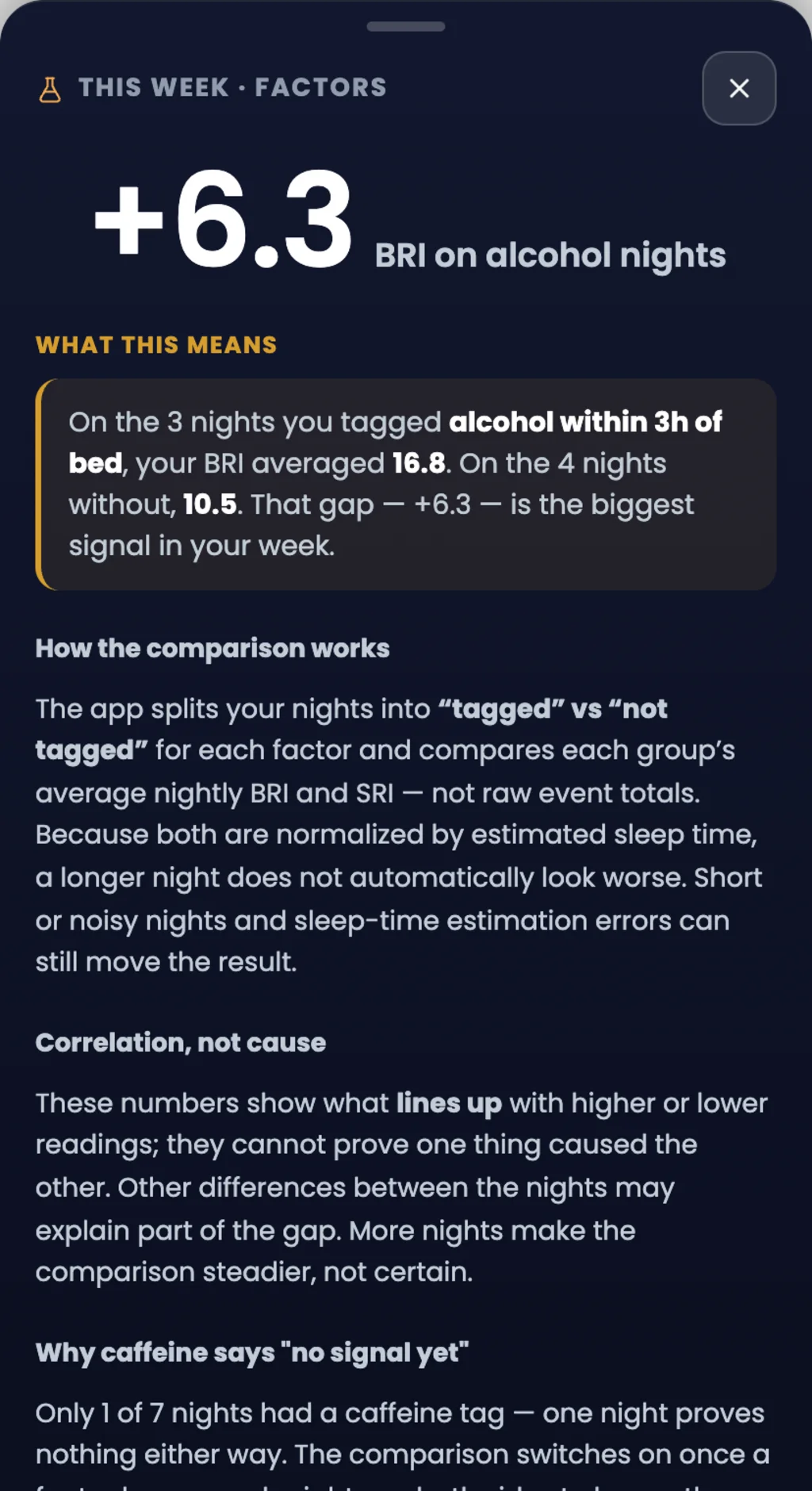
Trying a different pillow or another bedtime change can leave you wondering whether your nights look different. Tag what you tried, keep recording, and compare nights with and without the tag. Lifestyle Lab™ shows the observed difference and sample sizes. It does not tell you that a product or treatment worked.
The changes you already have in mind
Perhaps you already use a different pillow, follow a wind-down routine, or notice differences between workdays and weekends. Tags let you describe those nights without assuming why they differ.
Some nights may seem different after a routine changes. A tag keeps that context alongside the recording; it does not separate the routine from ordinary variation or other changes.
A single better-looking night cannot settle the question. Comparing several nights gives you more context, while leaving other possible explanations open.
About 30 seconds before bed
Tap what's true tonight. It takes about as long as setting an alarm. Six factors you might want to tag:
🍷 alcohol · ☕ late caffeine · 😰 stress · 🍽️ large meal · 💊 existing prescribed medication · 🏃 a hard workout
Examples of routines or existing care you might record:
🛌 intended side-sleeping · 📐 usual head elevation · 👃 clinician-directed nasal spray · 🪶 usual pillow · 😷 prescribed CPAP use · 🧘 wind-down routine. Record existing care as context; do not start, stop or change treatment to create an app comparison.
You sleep. SomniSense listens. The next morning your BRI lands in the report alongside the tags you set.
As your record grows, the Pro Factor Impact view groups nights by tag and shows the observed average difference between those groups.
Tagging is in the free tier. Factor comparison is a Pro view. More comparable nights generally provide better context, but no fixed number of nights makes an observational comparison causal.
How to read a factor comparison
An illustrative comparison might look like this:
- 🍷 Alcohol +3.2 BRI
- 🍽️ Large meal within 3 hrs +1.4 BRI
- 😰 High-stress day +2.3 BRI
- 🛌 Side-sleep −5.1 BRI
- 🪶 Anti-snore pillow −1.8 BRI
- ☕ No late caffeine −1.4 BRI
Illustrative values only. Your app shows your own tagged-night averages and sample sizes.
A +3.2 difference means the tagged-night average was 3.2 BRI points higher in that comparison. A −5.1 difference means it was lower. Neither result establishes that the tag produced the change; other differences between nights may contribute.
What this is — and isn't (don't oversell it to yourself)
- Observational, not controlled. No randomization, no blinding, no placebo. If side-sleep-tagged nights have a lower BRI, the tag does not establish any cause. Recording conditions, other routines and ordinary variation may also differ between groups.
- No magic sample size. A few nights can be dominated by ordinary variation. Keep the recording setup and other conditions as comparable as practical.
- Bodies and nights vary. An observed difference may change as more data arrives.
- Not a substitute for professional advice. Medication, CPAP, and health decisions belong with a qualified clinician.
Free basics stay available · Pro adds mature tagged-night comparison and longer evidence continuity.
Read next
- → See & Hear Playback — add local audio context to selected events
- → Alcohol and sleep — why a tag comparison still cannot establish cause
- → Every-Event Timeline — what your night looks like when you don't average it
- → Structured reports — organize multi-night observations