BREATHING PAUSES · CANDIDATE EVIDENCE
Breathing Pause Detection: Review the Candidate
SomniSense detects possible breathing pauses in the sound recorded by your bedside phone. Open a candidate to see its model-estimated time and duration, a marked waveform and its position in the night, then listen to the surrounding sounds. A sound pattern cannot confirm clinical apnea or hypopnea, measure AHI, or rule out sleep apnea.
Start with Free to review your first night. No new hardware needed.
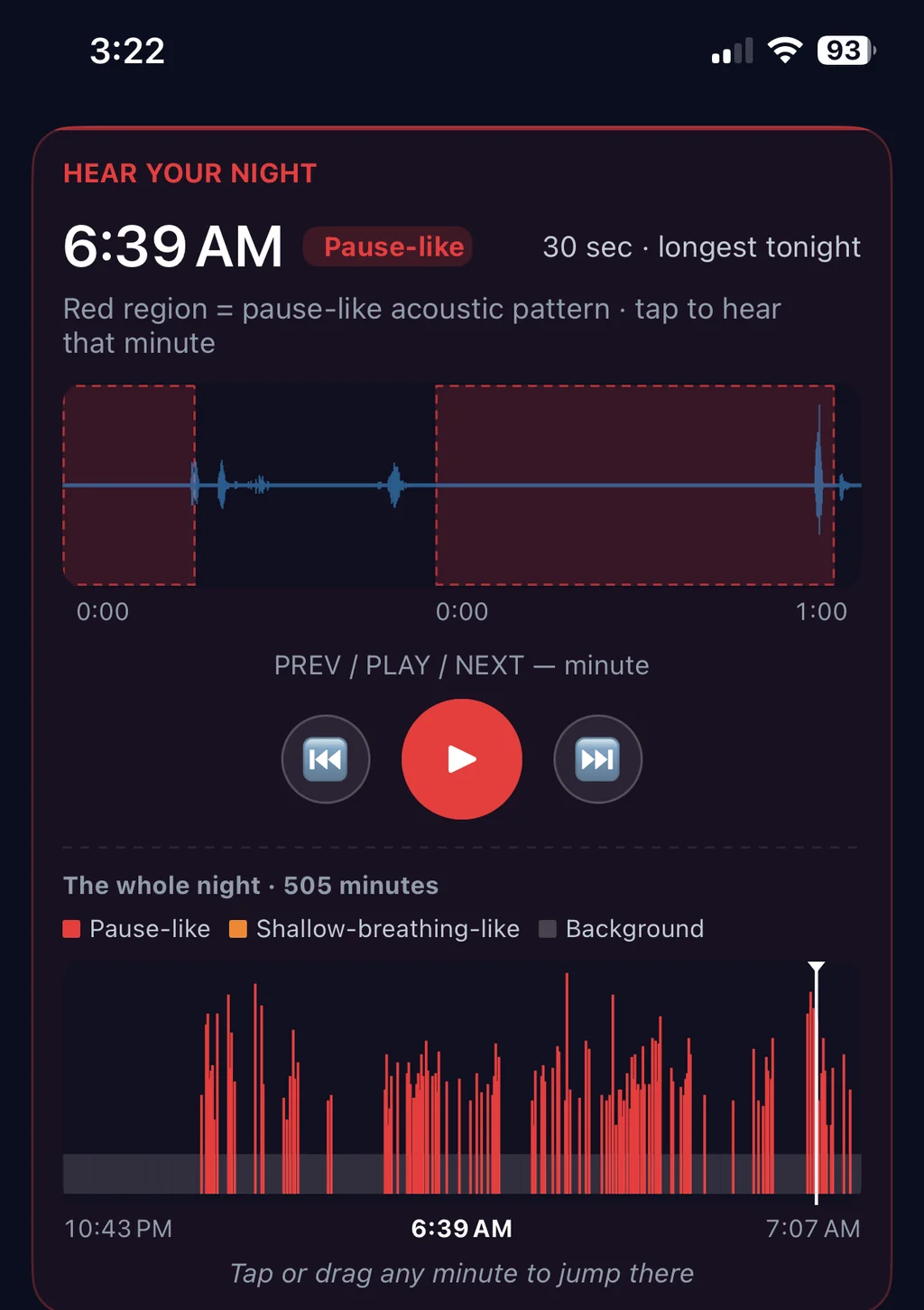
A bedside phone can record the sounds around a possible breathing pause. SomniSense marks candidate intervals so you can return to their estimated time and duration, see the waveform and hear the sounds before and after. It also summarizes observations in BRI, a product-defined rate per estimated sleep hour. BRI is not AHI, and SomniSense does not diagnose sleep apnea. The published production benchmark reports 88.49% accuracy on labeled 200-second breathing windows; it is not a claim that every event boundary, duration, or label is clinically validated.
Turn an invisible night into something you can review
You cannot observe your own sleep while it is happening. In the morning, SomniSense gives you a time-organized view of the acoustic patterns its on-device model flagged overnight.
In your morning Night Report, choose a candidate and play its surrounding recording. Follow the pointer from the sound before the quiet interval to the sound that resumes. On later nights, you can see whether a similar pattern appears again. Some nights will have no candidates; that result does not rule out a condition.
What the app can surface
SomniSense groups candidate acoustic patterns into two product labels:
- Pause-like patterns — an acoustic interval that resembles a sustained interruption in the recorded breathing pattern.
- Shallow-breathing-like patterns — a quieter or reduced acoustic pattern that the model marks for review.
These labels describe model output from phone audio. They do not establish airflow reduction, oxygen desaturation, arousal, airway anatomy, or a clinical apnea/hypopnea event.
What you can review in the morning
- Candidate pattern counts from the overnight audio analysis
- BRI for the night — product-defined events per estimated sleep hour
- Time-organized event list with model-estimated start time, duration, and type
- Selected local audio playback so you can inspect the underlying recording
- Multi-night trends to compare your own pattern over time
What the 88.49% benchmark means
Paper E reports 88.49% accuracy and 88.06% F1 for the compressed production model on labeled 200-second windows. That is the exact task the number describes.
It does not independently validate every event start, event end, duration, product label, bedroom, phone microphone, or personal result. Those are production outputs and real-world variables, not conclusions inherited automatically from the window benchmark. Read the validation boundary · See the technical research →
How to read BRI
Use BRI to compare your own nights under reasonably similar recording conditions. It is a wellness-monitoring index, not a clinical severity score, and clinical AHI thresholds should not be applied to it.
A persistent or concerning pattern can help you describe what you observed when speaking with a qualified clinician. Symptoms or urgent concerns should be evaluated medically regardless of what the app reports.
What this is not
- Not a diagnosis of obstructive sleep apnea (OSA). OSA diagnosis needs in-lab PSG or Type-III HSAT plus a sleep specialist's evaluation.
- Not validated for users under 18.
- Not a substitute for your CPAP's compliance report. If you're on CPAP, that machine's data is more authoritative for treatment decisions.
What it is: a wellness tool that organizes acoustic observations over time, so you can notice changes and decide whether to discuss them with a qualified clinician.
Free keeps core first-night candidate evidence, local playback within the app limits, and a recent 7-day trend.
Read next
- → How we validated accuracy
- → Understanding BRI — what the breathing index means and where its limits are
- → Every-Event Timeline — see each event individually
- → Structured reports — keep longer-period observations together