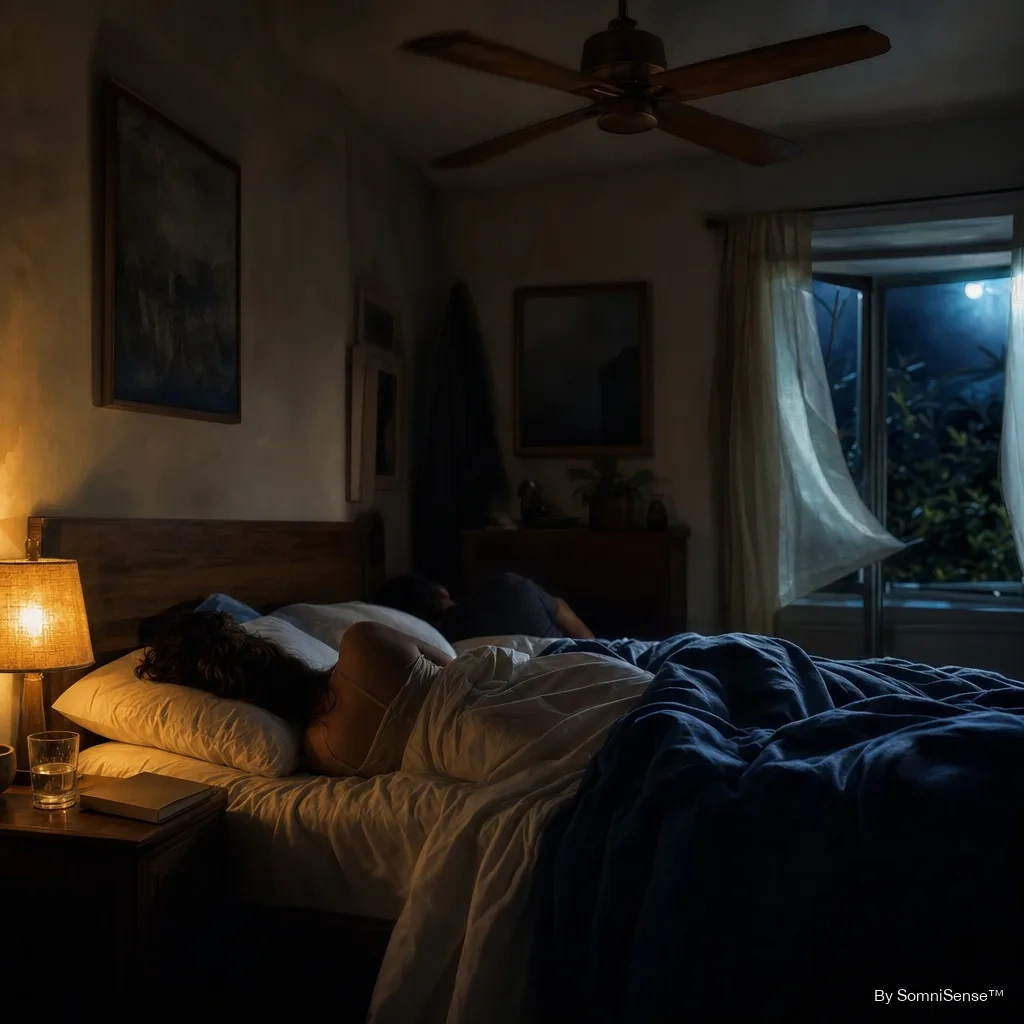
Body temperature, cortisol, and why some nights are just worse.
Most of the conversation about sleep is about behavior. Did you have wine? Did you check your phone? Did you go to bed at a reasonable hour? All of those matter. None of them, by themselves, explain why two reasonable nights with similar behavior can be very different in how they actually felt.
Underneath the behavior is some boring, mostly invisible physiology — body temperature, cortisol, muscle tone — that decides whether a given night will go well. The reason this matters is that once you know what those signals are doing, you understand why some nights you can't seem to fix with willpower, and others you don't have to fix at all.
The drop in core body temperature
Healthy adult sleep onset is tied to a drop in core body temperature of about 1°F (≈ 0.5°C) from your daytime baseline. The drop is what tells the body it's time to sleep — earlier in the evening, your hypothalamus shifts the set-point, blood vessels in your hands and feet dilate to release heat, and the deep-body temperature falls.
If anything keeps that drop from happening, sleep onset is harder, and the sleep itself is shallower:
- A bedroom that's too warm. If the air is at 75°F+ all night, the body's heat dump is harder. This is one of the reasons mattress-temperature systems (Eight Sleep, Pod, etc.) have a real effect — they're externally helping the body do something it's trying to do anyway. The temperature regulation isn't a gimmick; it's targeting an actual physiological mechanism.
- Late, heavy meals. Digestion generates heat. A large meal at 9 p.m. keeps your core temperature elevated past the time when it's supposed to be falling.
- Late intense exercise. Same direction. Your core stays elevated for hours after a hard workout. A 9 p.m. HIIT session means your body is asking to stay alert when it's also being asked to fall asleep. (Personal note: I switched my workouts to 5 p.m. and the sleep difference was visible inside a week.)
- Alcohol. Counter-intuitively, alcohol initially lowers core temperature, but the metabolic processing in the second half of the night reverses that — your temperature climbs around 3 a.m., right when REM is supposed to be doing its work. This is one piece of why "I felt sleepy from the wine" doesn't turn into "I slept well."
The cortisol curve
Cortisol is the stress / wakefulness hormone. It runs on a daily cycle: high in the morning (it's part of what wakes you up), gradually falling through the day, lowest around midnight, then climbing again before dawn.
For sleep to work, cortisol has to actually be at the bottom of the curve at bedtime. Most things that ruin sleep are somehow keeping cortisol elevated when it should be dropping:
- An anxious or stressful day that's still cycling at 11 p.m. The body doesn't get a memo that the workday is over.
- Late screen exposure — bright light to the eyes signals "morning" to the cortisol system.
- Late caffeine — the half-life is around 5 hours; a 4 p.m. coffee is still measurably present at bedtime.
- Late nicotine — same direction, faster acting. Even if it feels calming, the physiology is alerting.
- Late hard exercise — exercise spikes cortisol on purpose; you want that during the day, not at bedtime.
People who track HRV know this curve well — when cortisol stays elevated, HRV tanks. The two signals are tightly coupled. The reason a "stressful Tuesday" shows up as "rough Tuesday night" on a wearable isn't mystical; it's the cortisol that didn't get to drop.
How this connects to breathing events
Here's the part that's directly relevant if you're tracking BRI: the same things that block the temperature drop and cortisol drop also tend to make breathing events more frequent.
- Alcohol — relaxes throat muscles, blocks temperature drop, raises overnight cortisol. Triple effect on a single drink.
- Late hard exercise — muscle fatigue, including in the airway-supporting muscles. Body still hot. Cortisol still elevated. All three converge.
- Stress — keeps cortisol up. Cortisol affects muscle tone. Even if you haven't had a drink, the stressed body's airway is more collapsible than the relaxed body's.
This is why "having a hard day" frequently shows up as "high BRI night" even on a sober night. The mechanisms aren't separate. Stress, temperature, cortisol, airway muscle tone, and breathing events are all woven together.
It's also why fixing one thing often improves others. Cutting late alcohol moves all four. Moving exercise from 9 p.m. to 5 p.m. moves three of them. Side-sleeping moves the airway specifically without touching the others. The reason small lifestyle changes can move BRI significantly is that you're not just affecting one mechanism — you're touching several at once.
What to actually do with this
Don't try to optimize all of these at once. The system is too coupled and you'll lose track of what worked. Pick one variable for two weeks. Track. Then pick another.
- Bedroom temperature. Set the room around 65–68°F if you can. Cool before warm. If your partner runs hot, layered blankets work better than thermostat fights.
- Last meal 3+ hours before bed. Heavy meals especially. Late snacks if necessary, but not a full dinner.
- Last hard workout 3+ hours before bed. Easier said than done given work schedules, but it's a real lever.
- Caffeine cutoff at 2 p.m. Earlier if you metabolize slowly.
- Wind-down routine for the cortisol curve — dim lights, no harsh screens, something quiet. 30 minutes is usually enough.
None of these are dramatic. They're not what most "biohacking" content gets clicks on. They are, in our data, the small physiological levers that consistently move BRI.
Read next
If this is the kind of writing you'd want more of —
Drop your email. I'll send one note when SomniSense is downloadable. No marketing list, no second email unless you ask.
One email at launch. No newsletter, no list-sharing, no second email unless you ask.
First 7 days free at launch · then $7.99/mo or $49.99/yr.