FEATURE · SRI (SNORING RATE INDEX)
Snoring finally has its own number.
Other apps stop at "loudness 68 dB." We give snoring a proper per-hour rate — the Snoring Rate Index (SRI) — validated at 91% sensitivity vs PSG, plus a per-minute Q/L/M/H texture so you can see when the heavy minutes actually happened.
Launching soon. First 7 days free at launch · then $7.99/mo or $49.99/yr.
"You snored last night" isn't useful information
If your partner has told you that you snore, you already knew that. The interesting question is how often, how loud relative to the room, and when in the night the heavy minutes were happening. Most apps don't actually answer any of those — they hand you a peak-loudness number (68 dB) and call it a night.
So we gave snoring its own index — the same way breathing has BRI (and AHI, in clinical settings).
What SRI is, plainly
SRI = total snore events ÷ hours of monitored sleep. A per-hour rate, the same shape as BRI, the same shape clinicians have used for breathing events for decades. Your phone has to count snores anyway — we just stopped throwing the number away.
Some example ranges from our own data:
- Quiet — under 30/h. A handful of snores all night, mostly silent stretches. The night your partner doesn't bring it up the next morning.
- Light — 30 to 100/h. Audible-but-tolerable. The kind that becomes background noise.
- Moderate — 100 to 300/h. Persistent. Your partner has probably mentioned it.
- Heavy — over 300/h. Continuous through long stretches of the night.
These thresholds are product-defined, not clinical. SRI doesn't have an FDA category or a published medical threshold the way AHI does — we'll be the first to tell you. What it does have: 91% sensitivity and 98.5% precision validated against PSG (n=70+ paired nights). Methodology at /accuracy.
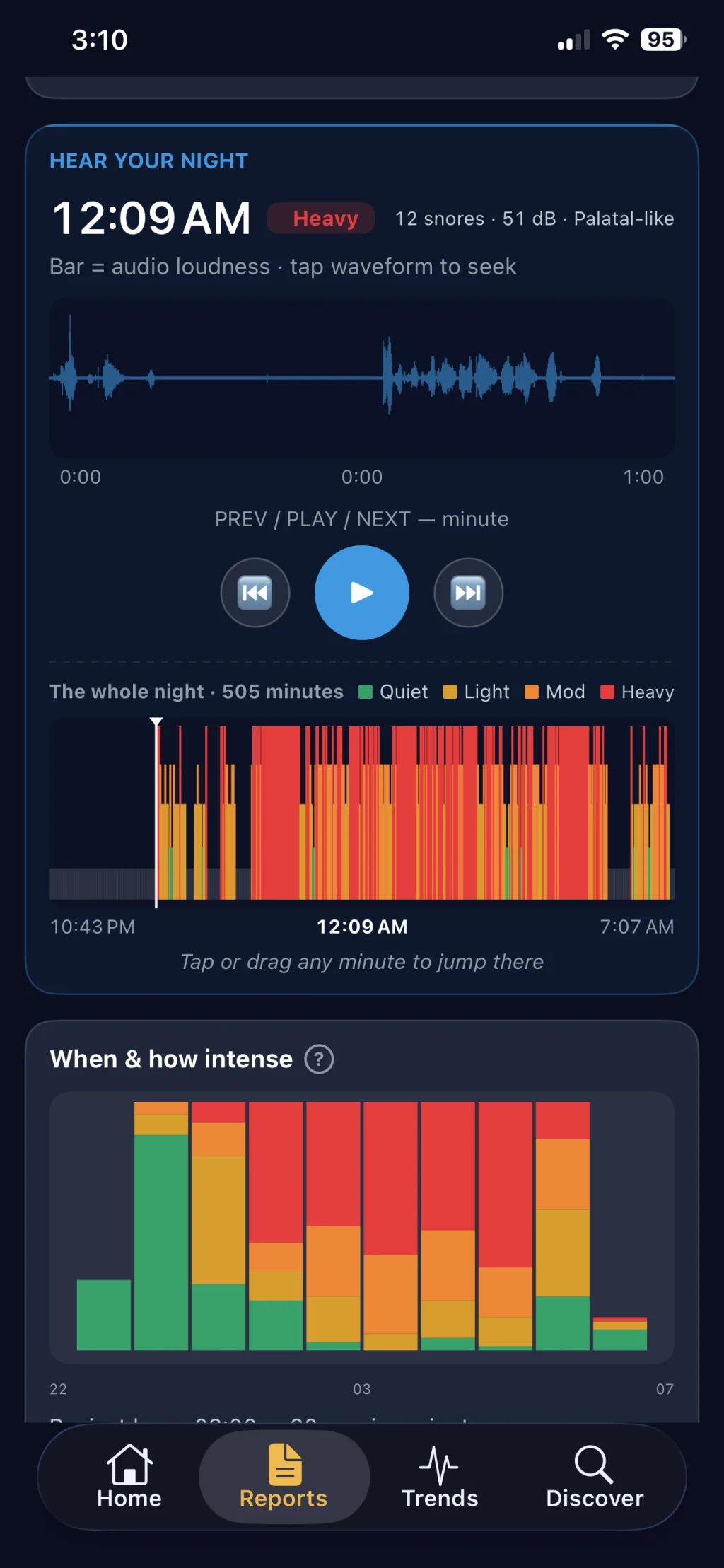
A rate alone hides the texture. So we added Q/L/M/H per minute.
SRI 100/h could mean snoring evenly all night, or it could mean a 2-hour Heavy stretch from 02:00 to 04:00 with the rest of the night quiet. Those are completely different sleeping experiences — for you and for whoever's next to you.
So every minute gets one of four bands, based on how many snore events the phone heard in that minute:
- Q (Quiet) — 0 events. Genuine silence.
- L (Light) — 1 to 4. Occasional, soft.
- M (Moderate) — 5 to 9. Frequent.
- H (Heavy) — 10 or more. Wall-to-wall in that minute.
The morning report shows the four percentages and a 15-minute color strip across the night so you can see the Heavy band concentrated where it actually happened. Most users discover their Heavy minutes cluster in a specific 90-minute window — that's where Lifestyle Lab™ experiments have something to grip onto.
The four snore types we classify (and why)
Two snorers with the same SRI can have completely different intervention paths. The acoustic signature tells us where in the airway the sound is being generated — and that's the part that decides whether side-sleep, an anti-snore pillow, a saline rinse, or an ENT visit is the next move.
Palatal — the soft-palate rumble
The soft palate (back of the roof of your mouth) vibrates as air passes. The snore most people picture. Worse with back-sleeping, alcohol, weight gain. Often improves with side-sleep, an anti-snore pillow, weight loss. Position-responsive — that's what makes this category actionable.
Tongue-base — the lower, irregular kind
The tongue slides back during deep sleep and partially blocks the airway. Lower-pitched than palatal, more uneven. More associated with breathing pauses than palatal snoring is — worth watching. Often improves with side-sleep, head-of-bed elevation, no alcohol within 3 hours of bed.
Nasal — the whistle or whine
The sound source is your nose, not your throat. Usually congestion, narrow nasal anatomy, or chronic inflammation. The intervention path is genuinely different — saline rinse, nasal strips, treating allergies, sometimes an ENT visit for polyps. A position experiment won't move it. If your SRI is mostly nasal, our app's response is "see your doctor about the nose," not "try side-sleeping for 14 nights."
Epiglottic — quieter but irregular
The epiglottis (cartilage flap above the voicebox) flaps during inhale. The most clinically associated of the four with apnea events. If your timeline shows frequent epiglottic events, that's a sleep-specialist conversation, not an at-home intervention.
SRI vs BRI — two indices, one app
People ask if SRI is just AHI under a new name. It isn't. They measure different things and they can move in opposite directions:
- BRI (Breathing Irregularity Index) — apnea + hypopnea events per hour. Same shape as AHI. The number that says is your breathing OK at night. A clinician can use it.
- SRI (Snoring Rate Index) — snore events per hour. The number that says how the room actually sounded. Your partner cares about this one.
You can have a Heavy SRI with a Normal BRI (you snore loudly but breathe fine). You can have a Quiet SRI with a Mild BRI (silent apneas, more common than people realize). You can have both elevated, or neither. The point of having two indices is to stop pretending those are the same thing.
Depth within SRI — Loudness above ambient
Inside your nightly report, SRI's headline number is paired with a per-minute Loudness pattern: the difference between your snoring peak and the room's background noise, minute by minute, averaged across the night.
The reason it's inside SRI and not its own index: dB is a relative energy measurement. Phone position, distance to your face, ambient temperature, microphone variance — all of it shifts the absolute number. So we don't compare your dB to anyone else's. We just track your own trend, night over night, and surface the factors that move it.
Loudness above ambient compares your snoring peak to the room's background noise. Phone position affects this measurement — track changes in your own data, not absolute values.
What you get per night
- SRI — events per hour, plus a Quiet / Light / Moderate / Heavy band
- Q/L/M/H per-minute texture — four percentages plus a 15-min color strip across the night
- 4 snore types — % of time in palatal / tongue-base / nasal / epiglottic
- Loudness above ambient — average and peak, plus the time of peak
- Time-stamped events you can play back (See & Hear Playback)
What this is — and isn't
- Not a clinical diagnostic. SRI is a SomniSense-defined index without an established clinical threshold. We made it up. (Carefully — but still.)
- Not a treatment recommendation. Snore-type classification is a hypothesis to test with Lifestyle Lab™, not a final answer.
- Not a diagnosis of where exactly your airway is collapsing — only an ENT exam can confirm that.
What it is: an honest per-hour snoring rate, plus a minute-by-minute texture, plus an acoustic classifier validated at 91% sensitivity and 98.5% precision against in-lab PSG (n=70+ paired nights). Methodology at /accuracy.
First 7 days of Pro are free · Cancel through the App Store or Google Play before day 7 to avoid the renewal charge.
Read next
- → How we validated 91% SRI / 80% BRI
- → Loud snoring symptom guide
- → Lifestyle Lab™ — test which interventions reduce YOUR SRI
- → See & Hear Playback — hear each classified event
- → BRI — the breathing-event side