WITH · COMPLEMENTARY DATA
Use SomniSense with your Fitbit
Fitbit gives you a wrist-based sleep view. SomniSense adds a separate phone-acoustic timeline, model-estimated candidate regions, and available audio for review.
Fitbit sleep and sound features vary by model and software; some supported features include snore and noise detection. SomniSense adds an independent bedside phone recording. Open a possible breathing pause, see its estimated timing and marked waveform, then listen to the surrounding sounds. That record cannot explain or verify a Fitbit score.
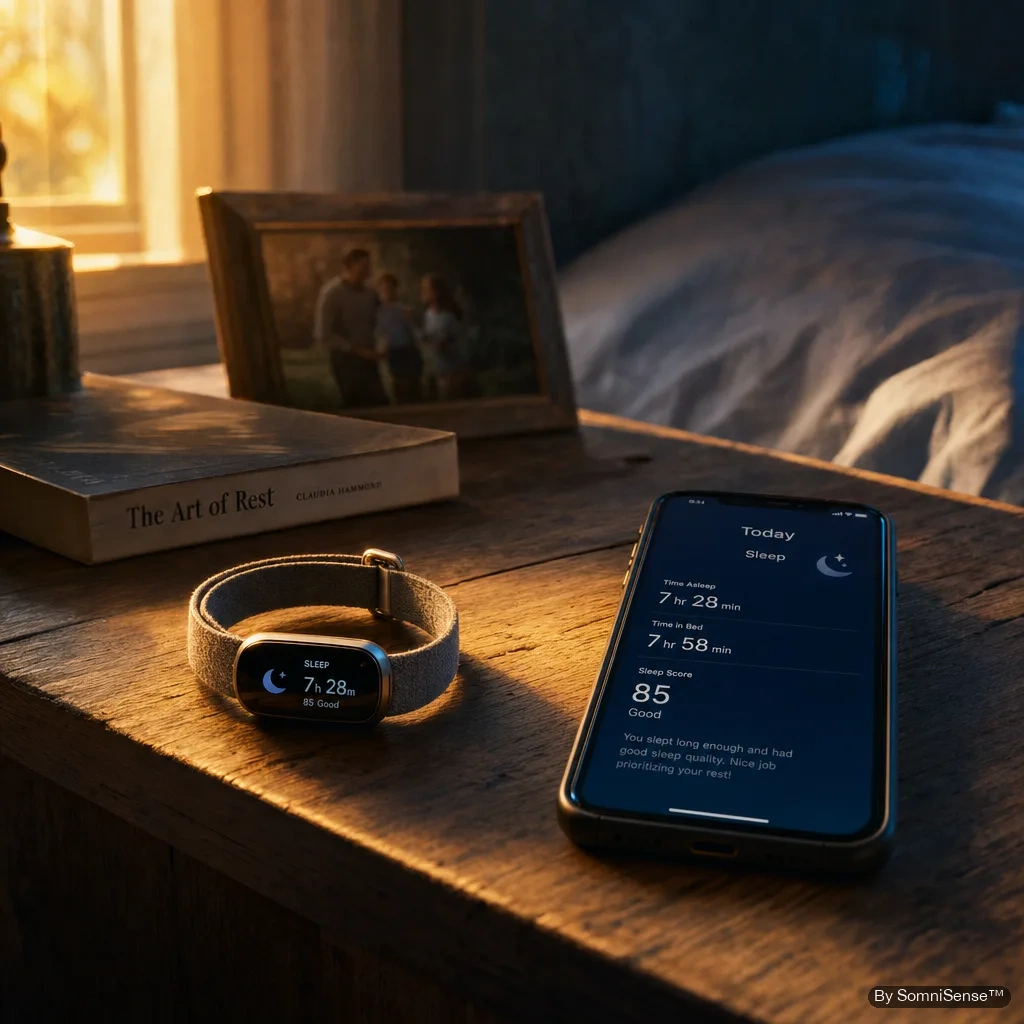
What Fitbit's been doing well for years
Fitbit products can provide wearable sleep views using the sensors and algorithms supported by a particular model and software version. Read those outputs within Google Health and Fitbit documentation. Google also documents a snore and noise detection device capability; that does not mean every model has it.
Those features have their own value. SomniSense provides a separate phone-audio record; it does not reproduce, import or grade Fitbit data.
What SomniSense adds, specifically
SomniSense uses the phone beside your bed to organize possible breathing pauses in a separate recording. You can inspect estimated times and durations and listen before and after the marked intervals, regardless of which Fitbit features your device supports.
Those regions do not prove apnea or hypopnea, and they do not explain a Fitbit score. They are a separate acoustic view with a clear method ceiling.
Concretely:
- Candidate-region timestamps + available audio — inspect what the microphone captured around selected regions.
- Snoring observations — timing, loudness, sound texture, and whole-night context without locating an airway source.
- A product-defined BRI trend — acoustic observations to review alongside, not as a replacement for, clinical data.
- Lifestyle Lab™ — compare nights with and without tags as an observational association.
What you get when you run both
| What you want to know | Fitbit answers | SomniSense answers |
|---|---|---|
| How long did I sleep? | Total + stages | — |
| How restless was I? | Movement events | — |
| What did the room microphone capture? | Snore and noise features vary by model and software; check current documentation | Selected candidate regions + available audio |
| Was my sleep score low for breathing reasons? | Neither product can establish the cause from these views alone | |
| Why was my deep sleep cut short? | Could be many reasons | Acoustic context only — not a causal answer |
| Compare nights carrying different tags | See available Fitbit views | Lifestyle Lab™ associations |
| Keep a longer-period record | Check the export options for your device and account | Structured English wellness report; content-dependent length |
If your Fitbit score and how you feel do not line up
A consumer score should not decide whether a persistent symptom deserves professional attention.
A consumer sleep score cannot identify every possible cause of how you feel, and SomniSense cannot fill in that cause. The two products provide separate observations.
SomniSense can group tagged and untagged nights and let you review selected local audio. Any difference is an association in that sample; it does not explain the Fitbit score or establish a clinical event.
Free keeps core first-night evidence, local playback within the app limits, and a recent 7-day trend · Pro adds longer continuity and fuller comparisons and reports.
Read next
Common questions
- Will SomniSense replace Fitbit's sleep score?
- No. Fitbit and SomniSense observe different signals and produce different product metrics. SomniSense adds a separate acoustic timeline, model-estimated candidate regions, and available local audio.
- Do I need both?
- Only if an independent bedside recording would help you review possible breathing pauses in context. Check the features of your Fitbit model before deciding what an additional record would add. SomniSense cannot explain a mediocre Fitbit score or identify the cause of poor sleep.
- Can the apps share data?
- No. The current product does not import Fitbit or Health Connect data. Compare the two apps manually by date.
- I have an older Fitbit. Does this still apply?
- Supported sleep features vary by model, region, account, and software. Check Fitbit's current documentation, then read SomniSense as a separate phone-audio record rather than a replacement.