Your watch said 92. Your BRI was 24. They are not the same scale.
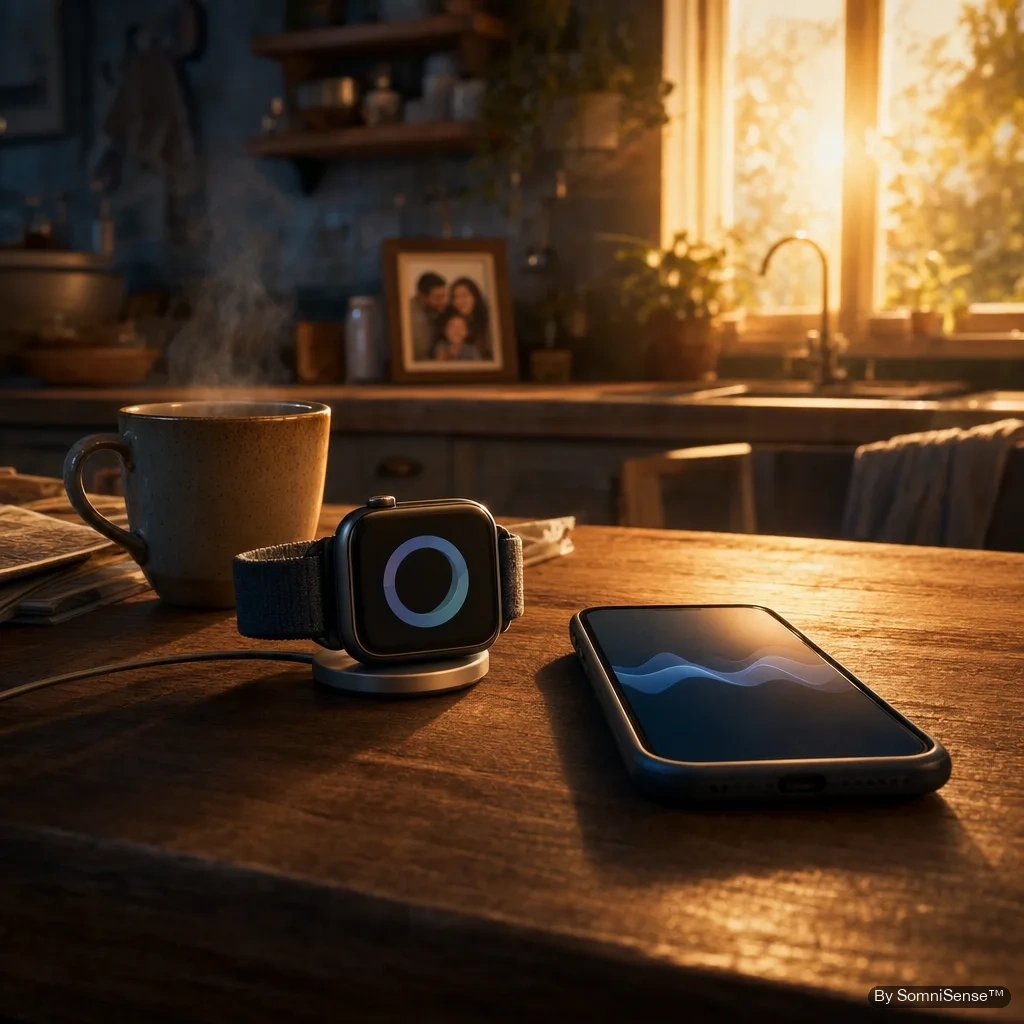
One confusing morning experience for someone using both a watch and a phone-based sleep monitor is seeing a strong watch sleep score alongside a higher SomniSense BRI.
The two products observe different signals, and neither value should be treated as automatically “right” about the other. BRI cannot be mapped to an OSA severity range.
The safe comparison starts with what each product says it measures, without using one consumer score to interpret the other.
What a watch sleep score actually measures
A sleep score is a product-defined composite. Inputs, scale, eligibility, and weighting vary by manufacturer, model, region, software, and feature.
Read the score within the maker's current documentation. SomniSense does not know or reproduce another product's proprietary formula.
Do not infer that a watch missed an airway closure, oxygen change, or clinical apnea from a SomniSense reading. SomniSense does not measure those facts either.
What BRI measures
BRI — Breathing Irregularity Index — is SomniSense's product-defined rate of candidate acoustic patterns per estimated sleep hour. It is not clinical AHI and does not directly measure airflow, oxygen, arousal, or sleep stage. (See Understanding BRI for the full boundary.)
What BRI does not measure: how long you slept, what stages you reached, how rested your nervous system feels, whether your heart rate was stable. Those are real signals; they're just not in this number.
A BRI value describes what the SomniSense acoustic model summarized for that session. It cannot be mapped to a clinical OSA severity category or used to override wearable or medical measurements.
Why the numbers can differ
The products use different sensors, algorithms, definitions, and scales. A difference between their scores is therefore expected and does not reveal what happened physiologically.
The combination does not support conclusions such as:
- that you are tolerating a disorder better than average;
- that a cardiovascular or cognitive load has been measured; or
- that one product is an early warning the other missed.
Neither a watch score nor a BRI value rules OSA in or out. Only appropriate clinical evaluation can answer that question.
Why both can be low
A low sleep score and low BRI also cannot identify the cause. A low BRI does not mean breathing was clinically “clean,” and the two consumer readings cannot rule medical or non-medical explanations in or out.
How to read them together
| Watch sleep score | BRI | Bounded interpretation |
|---|---|---|
| High | Low | Two consumer summaries using different definitions; no clinical conclusion. |
| High | High | The products' values differ in scale and meaning; neither explains the other. |
| Low | High | The products' values differ in scale and meaning; cause is unknown. |
| Low | Low | Fewer acoustic candidates were observed; this does not rule out a breathing or sleep condition or identify another cause. |
A longer record can provide context, but it does not become diagnosis through repetition. Seek professional guidance based on symptoms or concerns, regardless of either consumer score.
Read next
Record tonight. Take a closer look tomorrow.
Download SomniSense for iPhone or Android and start with Free. Your first Night Report helps you review what the phone recorded, including any candidate breathing moments. No candidates is a possible result too; it cannot rule out a medical condition.
Free covers the first-night core experience · Pro adds longer history, 30/90-day views, comparisons and fuller English reports