Sleep Apnea vs Snoring: What Is OSA?
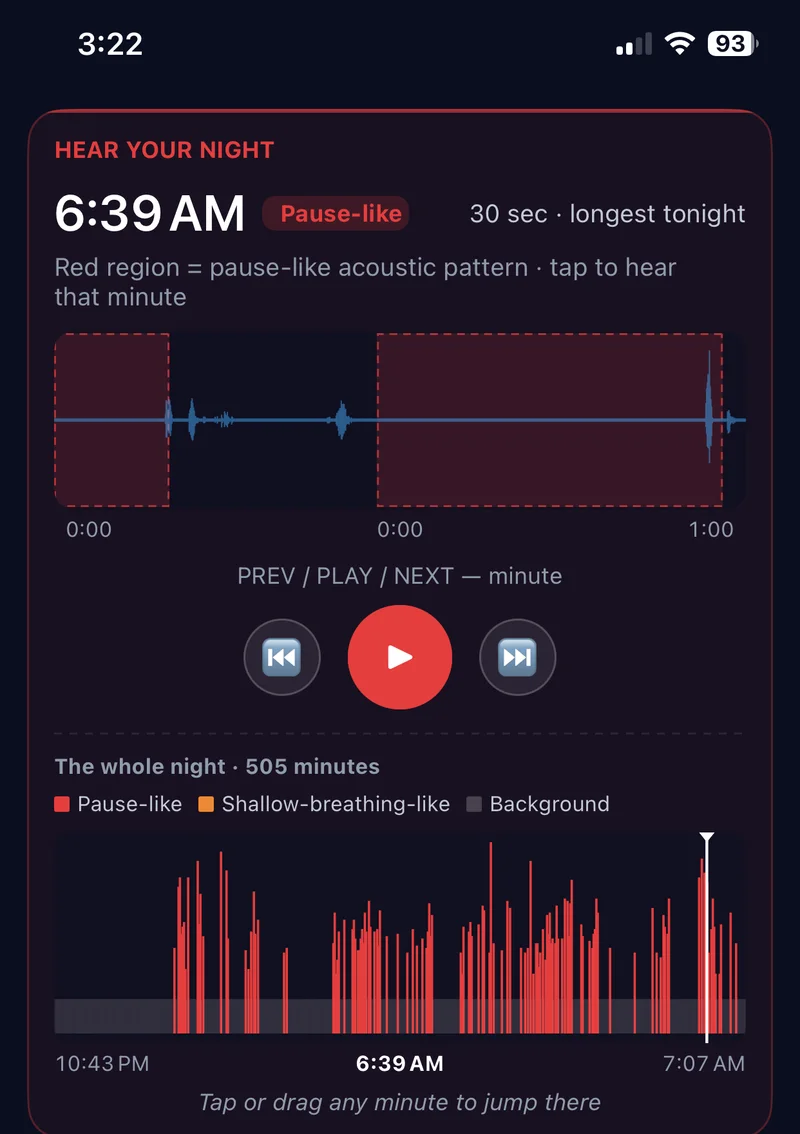
Snoring is a sound; obstructive sleep apnea (OSA) involves repeated upper-airway blockage during sleep. Sound alone cannot tell them apart. SomniSense marks candidate breathing pauses so you can review their estimated timing, waveform and surrounding sounds; it cannot diagnose or screen for OSA. Discuss witnessed pauses or gasping with a clinician without waiting for an app result.

Sleep apnea is a medical condition evaluated with clinical history and appropriate testing. Obstructive and central forms involve different mechanisms; a bedside microphone cannot distinguish them or establish a diagnosis.
Polysomnography and qualified home sleep apnea testing use physiological signals and professional interpretation. SomniSense uses one phone microphone and has a different, narrower role.
Common symptoms are worth discussing, but they are not specific
The U.S. National Heart, Lung, and Blood Institute lists symptoms that may occur with sleep apnea, including frequent loud snoring, breathing that starts and stops, gasping, daytime sleepiness or tiredness, focus problems, and headache. Other conditions and circumstances can produce overlapping symptoms.
Recurring gasping, witnessed pauses, persistent tiredness, or another concern can be a reason to speak with a qualified clinician regardless of what a consumer app reports.
What clinical testing adds
Clinical pathways can measure signals such as airflow, oxygen saturation, respiratory effort, sleep state, heart activity, and movement, depending on the test. A professional interprets those signals alongside symptoms and history.
Cost, scheduling, insurance, availability, and timing vary by location and care pathway. That variability does not reduce the clinical authority of the test.
What SomniSense can add before or between conversations
You can start tonight with the supported phone already beside your bed. The app organizes candidate acoustic regions by model-estimated time, type, duration, marked waveform, available local audio, and whole-night position.
Repeated nights may create a useful wellness baseline or structured report. They do not become a diagnosis through repetition, and BRI is not clinical AHI.
Source
NHLBI — Sleep Apnea Symptoms. Source rechecked September 5, 2026.
Read next
Record tonight. Take a closer look tomorrow.
Download SomniSense for iPhone or Android and start with Free. Your first Night Report helps you review what the phone recorded, including any candidate breathing moments. No candidates is a possible result too; it cannot rule out a medical condition.
Free covers the first-night core experience · Pro adds longer history, 30/90-day views, comparisons and fuller English reports
Questions behind this search
Apnea and hypopnea: what is the difference?
Clinically, apnea means airflow stops or nearly stops; hypopnea is reduced airflow assessed with accompanying physiological criteria. A quieter sound is not enough to classify either. Phone candidates are not these clinical events.
See how to review the evidence →
Sources checked September 6, 2026: NHLBI · NIH · AASM · hypopnea / AHI · AASM · PSG / HSAT / REI.