START WITH WHAT YOU NOTICED
Waking Up Gasping: What to Note and What to Do
Waking up gasping can occur with sleep apnea, but the symptom alone does not establish its cause. Discuss it with a clinician, especially when it repeats. Note the date, what you remember and any partner observations. SomniSense can add marked acoustic moments and surrounding sounds; a recording or a night without candidates cannot confirm or exclude OSA.
A phone may miss an event or capture a sound without revealing its cause. Recurring gasping deserves appropriate clinical attention regardless of the SomniSense reading.
WHAT SOMNISENSE ADDS
Turn a half-remembered moment into something you can revisit.
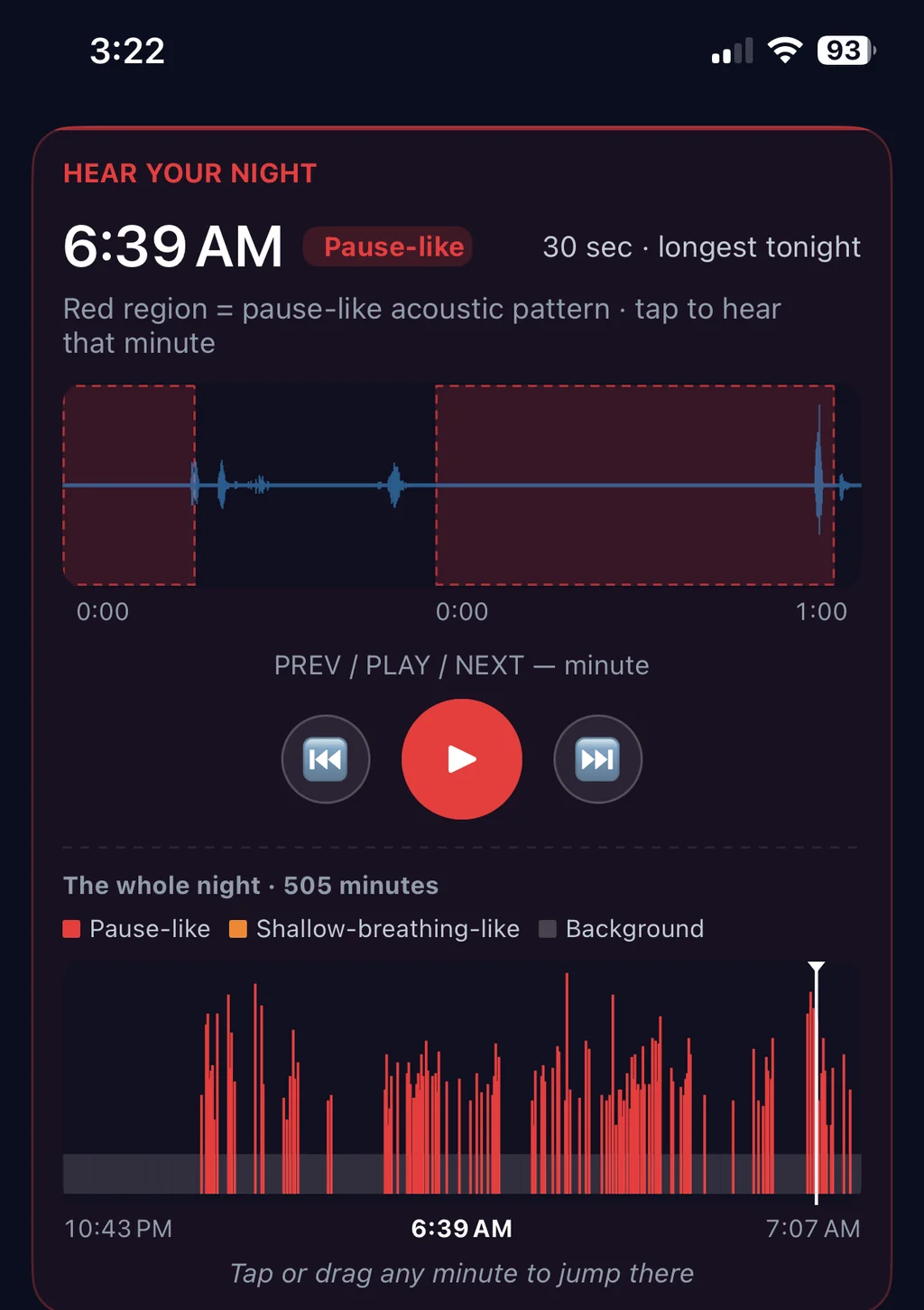
A bedside recording can give you a time to return to the next morning. Open a candidate to see its model-estimated duration and marked waveform, then hear the sounds before the quiet interval and as sound resumes. The phone may miss the moment, and it cannot explain why you woke gasping.
- Candidate pause-like or shallow-breathing-like type, time, and model-estimated duration
- The marked waveform and playback of the sounds before and after the candidate interval
- Whole-night position, followed across nights in recent comparisons and structured reports
Phone audio is a limited wellness signal. Candidate regions are not clinical apnea events, AHI, oxygen measurements, airway-source findings, or a diagnosis.
Gasping during sleep is a symptom, not a diagnosis. Write down what you felt and when it happened. If you choose to record another night, use the result as additional context — not as a test that can rule a condition in or out.
Similar experiences can have different causes
People may use “gasping,” “choking,” “couldn’t catch my breath,” or “woke with my heart racing” to describe different events. Sleep-disordered breathing is one possibility, but reflux-related irritation, panic arousals, respiratory or cardiac problems, medication effects, and other factors can overlap in how they feel.
That overlap is why neither the sound alone nor a product-generated label should be treated as the answer.
What to write down after an event
- The approximate time and whether you had just fallen asleep or had been asleep for hours.
- What you felt: choking, coughing, reflux, racing heart, breathlessness, or panic.
- How long the sensation lasted and whether it resolved fully.
- Anything a partner observed before or after you woke.
- Whether it has happened on other nights.
These notes remain useful even when a microphone does not capture a clear event.
What a SomniSense recording may add
- A whole-night timeline of product-flagged acoustic regions.
- Product-estimated times that you can compare with your memory or a partner note.
- Playback of the recorded sounds around a candidate, with its marked waveform for context.
- Several nights of observations to see whether a pattern appears again.
It cannot tell whether a gasp came from obstructive sleep apnea, reflux, panic, a cardiac issue, or another cause. It also cannot prove that no event occurred when none appears in the report.
When the next step should be clinical
Consider discussing the symptom with a qualified clinician when it recurs, when a partner observes repeated pauses or choking, when daytime sleepiness affects normal activities, or whenever the experience continues to worry you.
If you currently have severe or persistent shortness of breath, chest pain, fainting, new neurological symptoms, or another emergency concern, use your local emergency service instead of waiting to record another night.
What to bring to the conversation
- Your notes about time, sensation, recurrence, and partner observations.
- A list of current medications and relevant health history.
- A multi-night SomniSense wellness summary if you already have one.
- A few representative audio moments, if available and if the clinician finds them useful.
A clinician can decide whether a home sleep apnea test, an in-lab sleep study, or another evaluation is appropriate. The SomniSense summary is supplementary context, not a substitute.
Common questions
What can cause waking up gasping?
Several sleep, respiratory, digestive, cardiac, medication-related, and anxiety-related factors can produce similar experiences. A symptom description or phone recording cannot distinguish the cause.
When should I talk with a clinician?
Recurring gasping, partner-observed breathing pauses, choking, or persistent daytime sleepiness are reasonable reasons to seek clinical guidance. Do not use a low app reading to dismiss a recurring symptom.
When is it urgent?
If you currently have severe or persistent shortness of breath, chest pain, fainting, new neurological symptoms, or another emergency concern, use your local emergency service rather than relying on an app.
Can a phone recording diagnose sleep apnea?
No. Phone audio may add timestamps and locally available sound context, but it does not measure airflow, oxygen, breathing effort, EEG, or the other signals used in clinical testing.
What if my BRI is low but I still gasp awake?
A low BRI cannot rule out a sleep or medical condition. The symptom and its recurrence matter independently of the app value.
A recording may add context; it cannot promise to capture an event or explain its cause.
Read next
Keep several nights of observations in one clear report.
Longer-period structured reports organize candidate acoustic events, trends, tags, sample coverage, method, and limits. Save one for your own review or share it as background for a conversation. PDF reports are currently available in English.