START WITH WHAT YOU NOTICED
Your Partner Heard Snoring, Then a Pause
A partner hearing snoring followed by silence or a gasp is describing an observation, not confirming sleep apnea. Discuss witnessed pauses with a clinician. A bedside recording can give both of you a specific moment to revisit: SomniSense marks possible pauses with estimated timing, waveform and surrounding sounds. You do not need an app finding before seeking an evaluation.
SomniSense can organize snoring, candidate breathing regions, timestamps, and locally available audio. It cannot confirm that a breathing pause was sleep apnea or determine its severity.
WHAT SOMNISENSE ADDS
Give both of you a moment you can come back to.
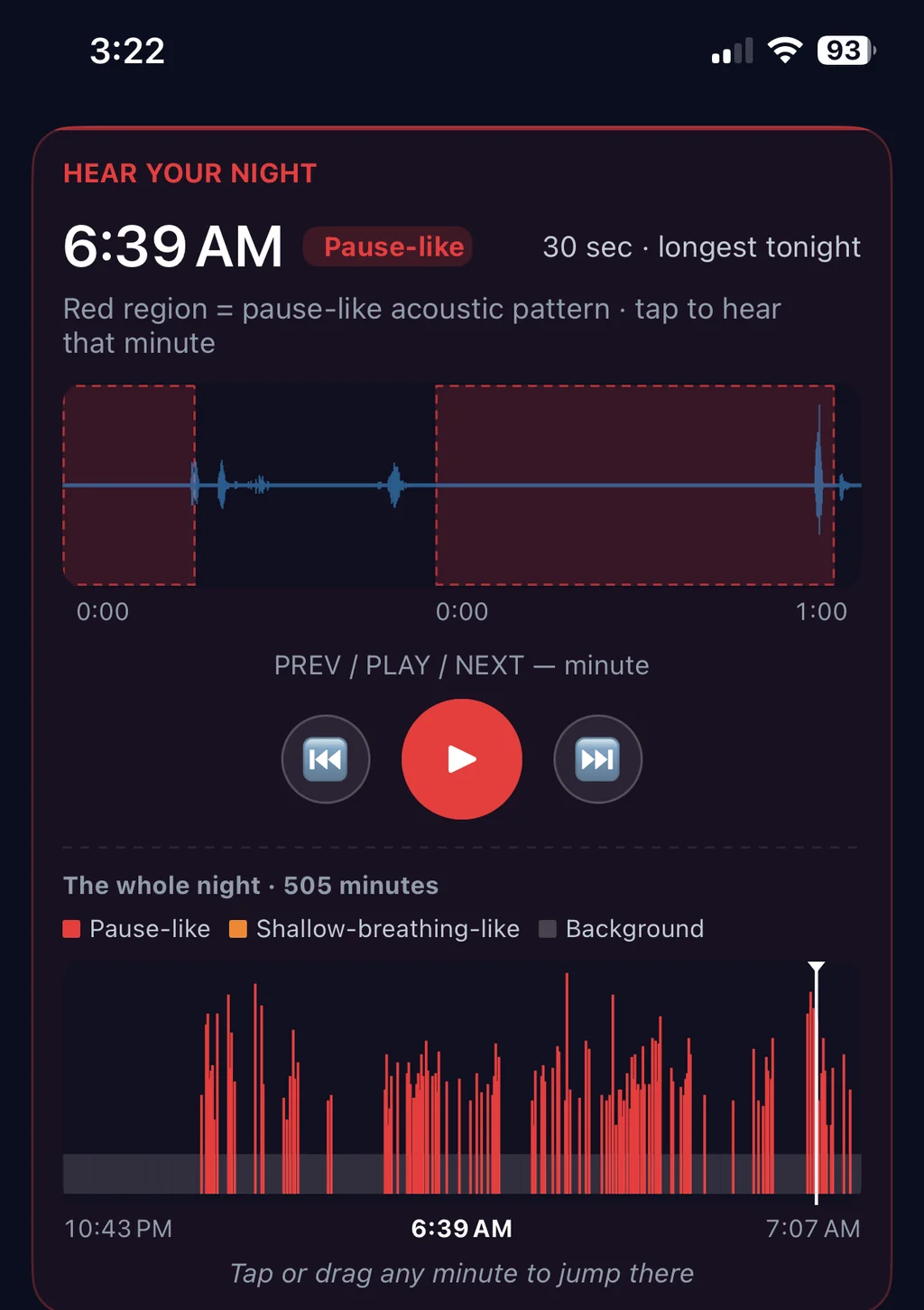
Start with a marked moment in the night. See the model-estimated time and duration, then follow the waveform while listening to the sound before the quiet interval and the sound that resumes. It gives you something concrete to discuss, while leaving the medical question to a clinician.
- Candidate pause-like or shallow-breathing-like type, time, and model-estimated duration
- The marked waveform and playback of the sounds before and after the candidate interval
- Whole-night position, followed across nights in recent comparisons and structured reports
Phone audio is a limited wellness signal. Candidate regions are not clinical apnea events, AHI, oxygen measurements, airway-source findings, or a diagnosis.
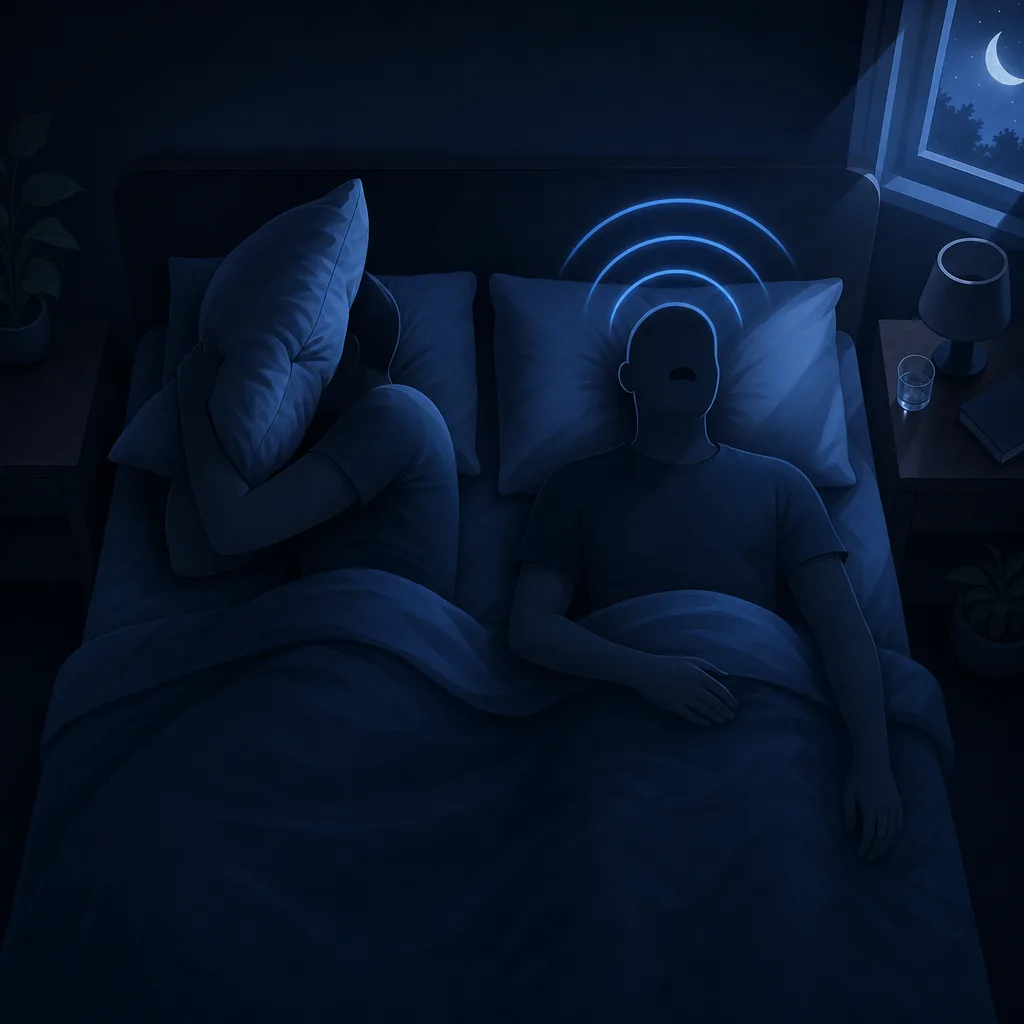
Do not start by deciding whether your partner is right or wrong. Start with one night both of you can review. The recording may clarify when snoring was audible and what happened around product-flagged regions, but it cannot explain the medical cause.
Listen to the observation, without turning it into a diagnosis
Your partner may describe steady snoring, very loud snoring, sudden quiet followed by a gasp, or repeated moments that looked like breathing stopped. Those descriptions are useful context, but neither a partner observation nor a phone recording can diagnose obstructive sleep apnea.
If your partner repeatedly notices pauses, gasping, choking, or becomes frightened by what they see, treat that concern seriously and consider a qualified clinical conversation. You do not need to wait for a particular SomniSense score.
Use one simple sentence tonight
“I cannot hear myself while I am asleep. I’ll record tonight, and we can look and listen together tomorrow.”
This keeps the goal practical: understand the night better. It avoids promising that one recording will settle every question.
What to review together tomorrow
- Start with the whole-night timeline instead of one summary number.
- Notice when snoring or candidate breathing regions clustered.
- Open a candidate and listen to the sounds before and after the marked interval.
- Compare the recording with what your partner remembers.
- Write down any recurring gasping, choking, or observed pauses you may want to discuss with a clinician.
A missed or quiet event is still possible. Absence from the app does not prove that nothing happened.
What SomniSense can — and cannot — add
- Can: organize product-estimated timestamps and candidate acoustic regions.
- Can: keep snoring and breathing observations in separate views.
- Can: let you review locally available audio while it remains on the phone.
- Can: compare several nights and tagged versus untagged observations.
- Cannot: measure airflow, oxygen, breathing effort, or sleep stages like a clinical test.
- Cannot: confirm sleep apnea, severity, or which intervention you should use.
If you want to keep observing, build a calm baseline
Use the first few nights to understand normal variation. If you later try one change — such as side sleeping or avoiding a late drink — tag it clearly and compare repeated nights. Treat any difference as an association to explore, not proof that the change treated a condition.
If your partner continues to report pauses, gasping, or choking, or if daytime sleepiness affects safety and daily life, seek professional guidance rather than extending the experiment indefinitely.
Common questions
Could my partner be mistaken?
A half-awake memory can be imprecise, but the experience still matters. A phone recording may add timestamps and locally available audio to review together; it cannot determine the medical meaning of what was heard.
My partner uses earplugs. Does that solve it?
Earplugs may reduce the sound for your partner, but they do not explain your snoring or any reported breathing changes. If either of you remains concerned, record the observation and consider an appropriate clinical conversation.
How do I bring this up without it becoming a fight?
Keep the first step small: "I cannot hear myself while I am asleep. Let us record one night and look at it together tomorrow." Treat the recording as context, not a verdict.
What if the app shows a high breathing reading?
A SomniSense reading does not confirm sleep apnea or its severity. Repeated partner-observed pauses, gasping, choking, or persistent daytime sleepiness deserve clinical attention regardless of the app value.
Is one night enough?
One night can start the conversation. Several usable nights show whether an observation repeats, but no number of phone recordings replaces a clinical sleep test.
Free keeps snoring, core first-night candidate evidence, local playback within the app limits, and a recent 7-day trend.
Read next
Keep several nights of observations in one clear report.
Longer-period structured reports organize candidate acoustic events, trends, tags, sample coverage, method, and limits. Save one for your own review or share it as background for a conversation. PDF reports are currently available in English.