Why your sleep audio never leaves your phone.
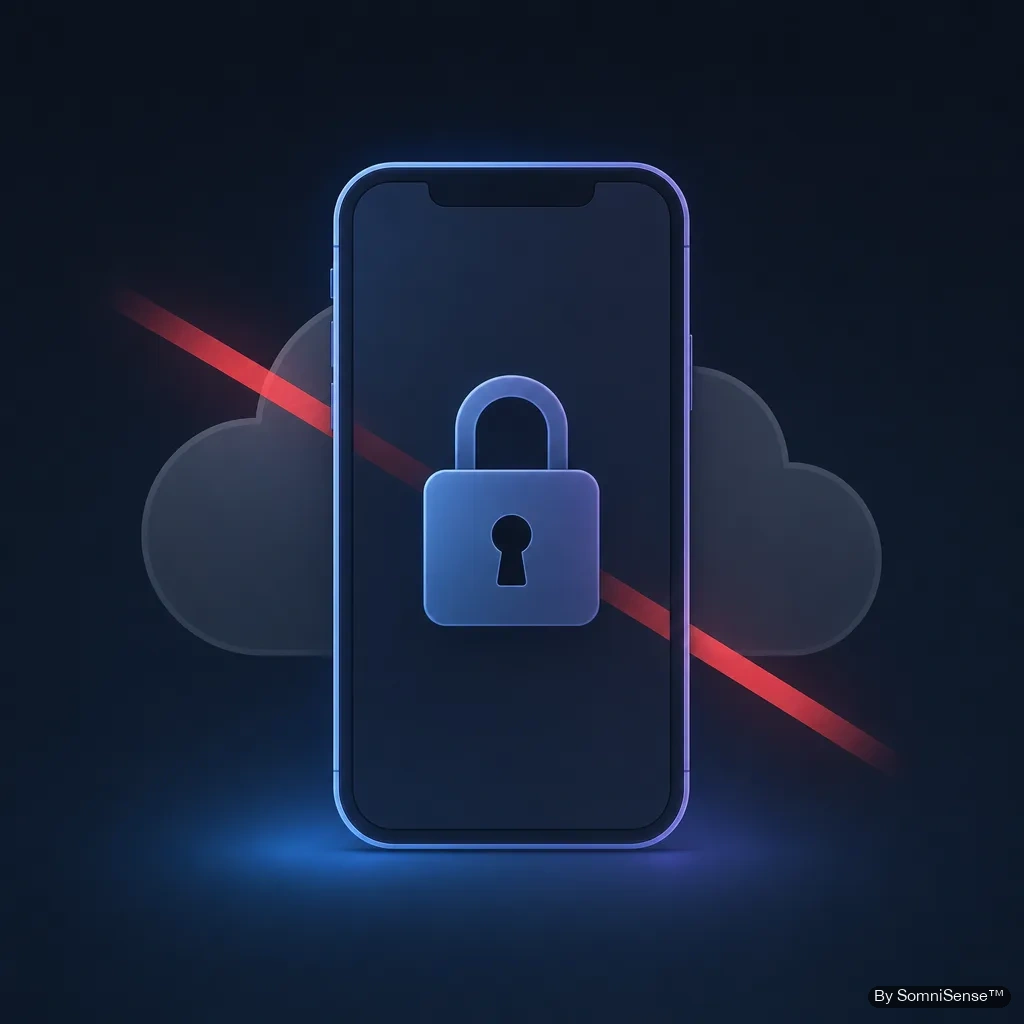
When I describe SomniSense to people, there's a moment where their face changes. "Wait — it records audio? All night? In my bedroom?" Yes. And I understand exactly why that lands wrong, because if that audio went to a server somewhere, I'd be uncomfortable too.
So here's the thing I lead with now: the audio never leaves your phone. It isn't uploaded, it isn't stored in our cloud, it isn't anywhere I could get to it even if I wanted. And the reason I can say that confidently isn't a privacy policy. It's the way the thing is built.
"On-device" gets said a lot. Here's what it has to mean.
For SomniSense, on-device means the phone performs the acoustic analysis, organizes snoring observations and candidate breathing-pattern regions, and builds the morning report locally. Raw sleep audio stays on the device unless you explicitly choose to share a selected clip.
The hard part is that this is genuinely difficult to pull off. A model that can analyze a night of audio is normally big — too big and too slow to live on a phone. The usual shortcut is to ship the audio to a powerful server and let it do the thinking. That shortcut is exactly what creates the privacy problem: once your bedroom audio is on someone's server, it can be logged, breached, subpoenaed, or quietly used to train something.
We made the model small instead
The compressed breathing-classification model is small enough to run on the phone. Its published model-size and inference measurements describe that model under the stated test conditions, not the size of the entire app or a speed guarantee for every phone. See the research page for the model, measurement hardware and limits.
Getting there wasn't one clever trick; it was a two-stage design that throws away almost everything before the heavy work happens, plus a compression pass that shrinks the network without losing accuracy. If you want the actual architecture — how a one-second listener feeds a longer reader, and how the model gets compressed — that's written up on the research page, including the preprints behind it.
The point for you is simpler: small model, on your phone, no cloud. Privacy stopped being a promise I make and became a fact of the design.
What this does and doesn't mean
Raw sleep audio stays on your device by default. Account and subscription information, aggregated sleep statistics, and technical context may be sent to operate account history, trends and reports, as described in the privacy policy. Audio leaves the phone only through an explicit export or sharing action. You can delete locally retained recordings in the app.
It does not mean SomniSense knows more about your health than a doctor does. It's a wellness monitor. It surfaces a pattern from sound. What that pattern means medically is still a clinician's call — we just made sure the raw material of it never has to leave your nightstand to be useful.
Read next
- → The research behind SomniSense — the two-stage model and how it gets small enough to run locally
- → What phone audio adds to wearable breathing data — a separate recording to review
- → See & Hear playback — how the audio you keep on your device works in the app
Record tonight. Take a closer look tomorrow.
Download SomniSense for iPhone or Android and start with Free. Your first Night Report helps you review what the phone recorded, including any candidate breathing moments. No candidates is a possible result too; it cannot rule out a medical condition.
Free covers the first-night core experience · Pro adds longer history, 30/90-day views, comparisons and fuller English reports